IB DP Physics: HL復習筆記9.3.4 The Diffraction Grating Equation

The Diffraction Grating Equation
- The angles at which the maxima of intensity (constructive interference) are produced can be deduced by the diffraction grating equation:
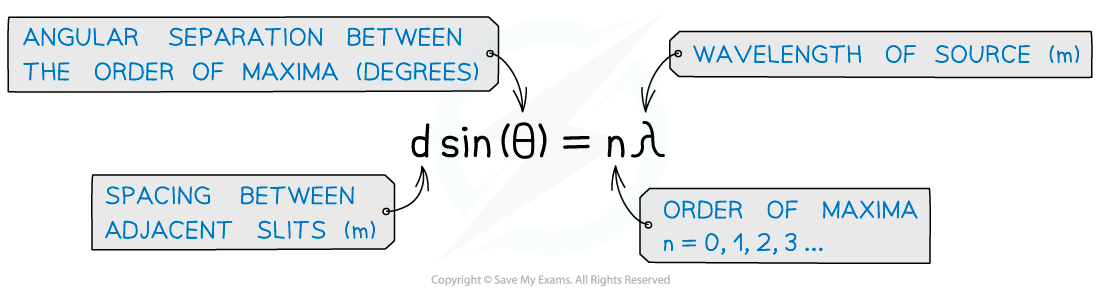
- The?lines per m?(or per mm, per nm etc.) on the grating is usually represented by the symbol?N
- Therefore, the spacing between each slit,?d, can be calculated from?N?using the equation:

Angular Separation
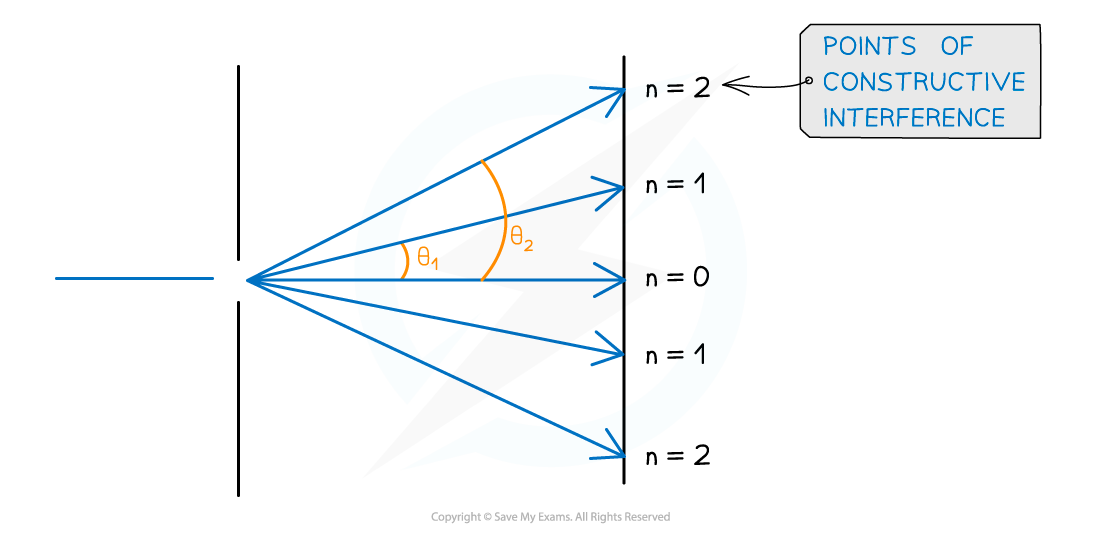
- The angular separation of each maxima is calculated by rearranging the grating equation to make θ the subject
- The angle θ is taken from the centre meaning the higher orders are at greater angles
Angular separation
- The angular separation between two angles is found by subtracting the smaller angle from the larger one
- The angular separation between the first and second maxima n1?and n2?is?θ2?–?θ1
Orders of Maxima
- The maximum angle to see orders of maxima is when the beam is at right angles to the diffraction grating
- This means?θ?= 90o?and sin?θ?= 1
- The highest order of maxima visible is therefore calculated by the equation:

- Note that since?n?must be an integer, if the value is a decimal it must be rounded?down
- E.g If?n?is calculated as 2.7 then?n?= 2 is the highest order visible
Worked Example
An experiment was set up to investigate light passing through a diffraction grating with a slit spacing of 1.7 μm. The fringe pattern was observed on a screen. The wavelength of the light is 550 nm.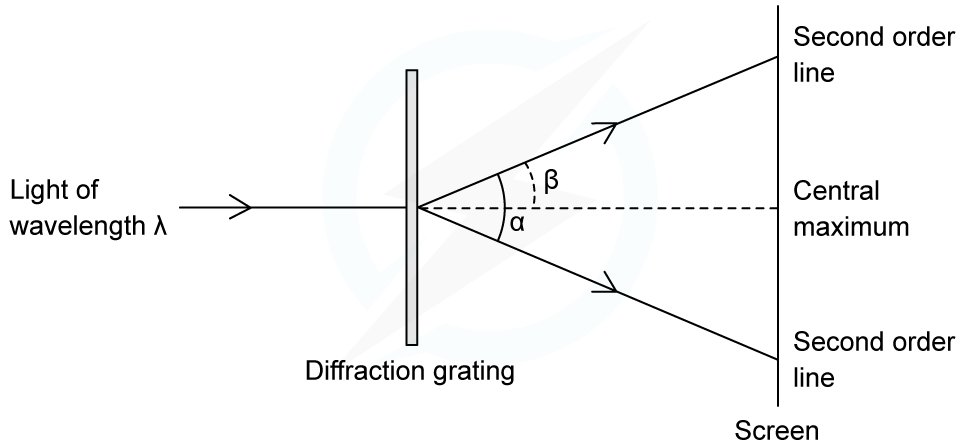
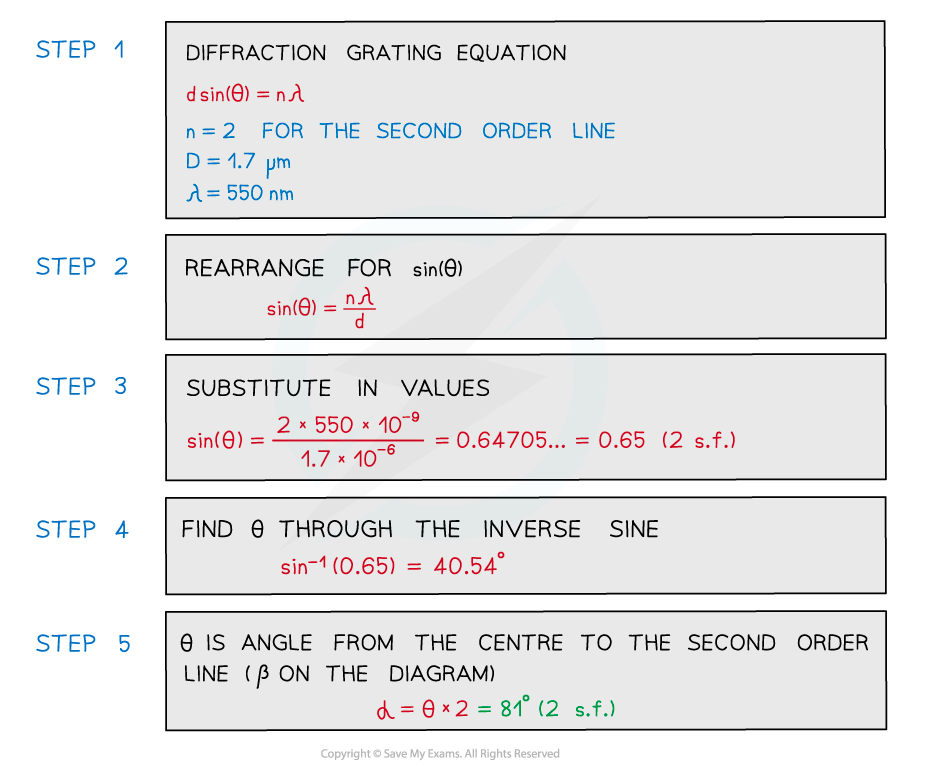
Calculate the angle α between the two second-order lines.
Derivation of the Diffraction Grating Equation
- When light passes through the slits of the diffraction grating, the path difference at the zeroth order maximum is zero
- At the first-order maxima (n = 1), there is constructive interference, hence the path difference is λ
- Therefore, at the nth order maxima, the path difference is equal to nλ
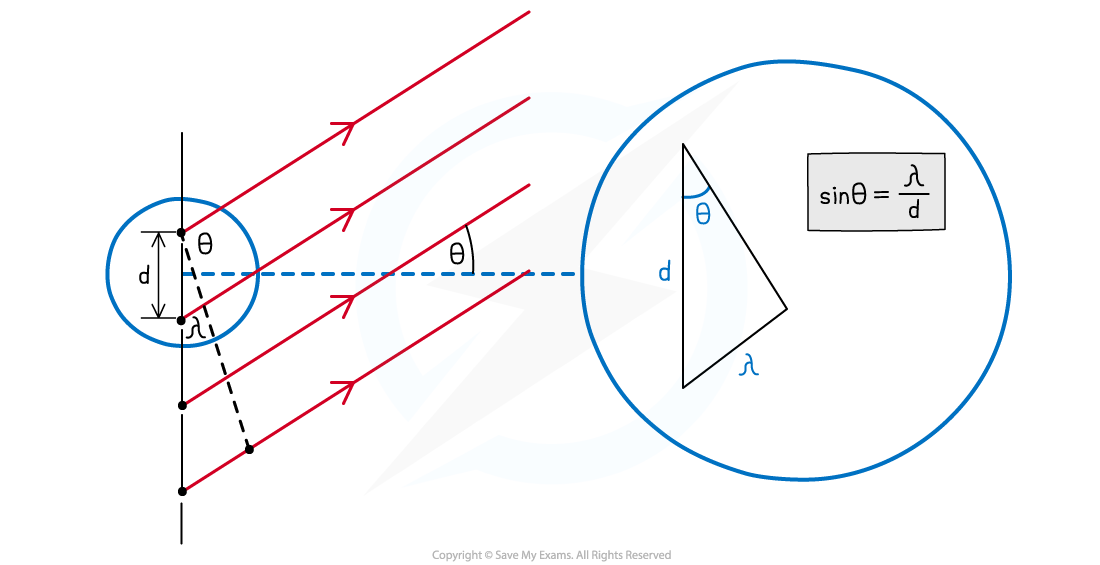
Using this diagram and trigonometry, the diffraction grating equation can be derived
- Using trigonometry, an expression for the first order maxima can be written:

- Where:
- θ?= the angle between the normal and the maxima
- λ?= the wavelength of the light (m)
- d?= the slit separation (m)
- This means, for n = 1:

- Similarly, for n = 2, where the path difference is 2λ:

- Therefore, in general, where the path difference is nλ:

- A small rearrangement leads to the equation for the diffraction grating:
d?sin?θn?=?nλ
Exam Tip
Take care that the angle θ is the correct angle taken from the centre and?not?the angle taken between two orders of maxima.
轉載自savemyexams
以上就是關于【IB DP Physics: HL復習筆記9.3.4 The Diffraction Grating Equation】的解答,如需了解學校/賽事/課程動態,可至翰林教育官網獲取更多信息。
往期文章閱讀推薦:
MIT官方發布【2026年夏季推薦閱讀書單】!橫跨科學/人文/經濟...


翰林AMC8視頻課重磅上線!

國際競賽真題資源免費領取






