IB DP Physics: HL復習筆記2.2.6 Friction

Friction
- Friction is a force that works in?opposition?to the motion of an object
- It occurs between two?solid bodies?that are?in contact?with one another
- The opposition of?friction slows?down the motion of the object
- When friction is present, energy is transferred in the form of?heat
- This raises the?temperature?(thermal energy) of the object and its surroundings
- The work done against the frictional forces causes this rise in the temperature
- Imperfections?at the interface between the object and the surface bump into and rub up against each other
- Not only does this slow the object down but also causes an increase in?thermal energy
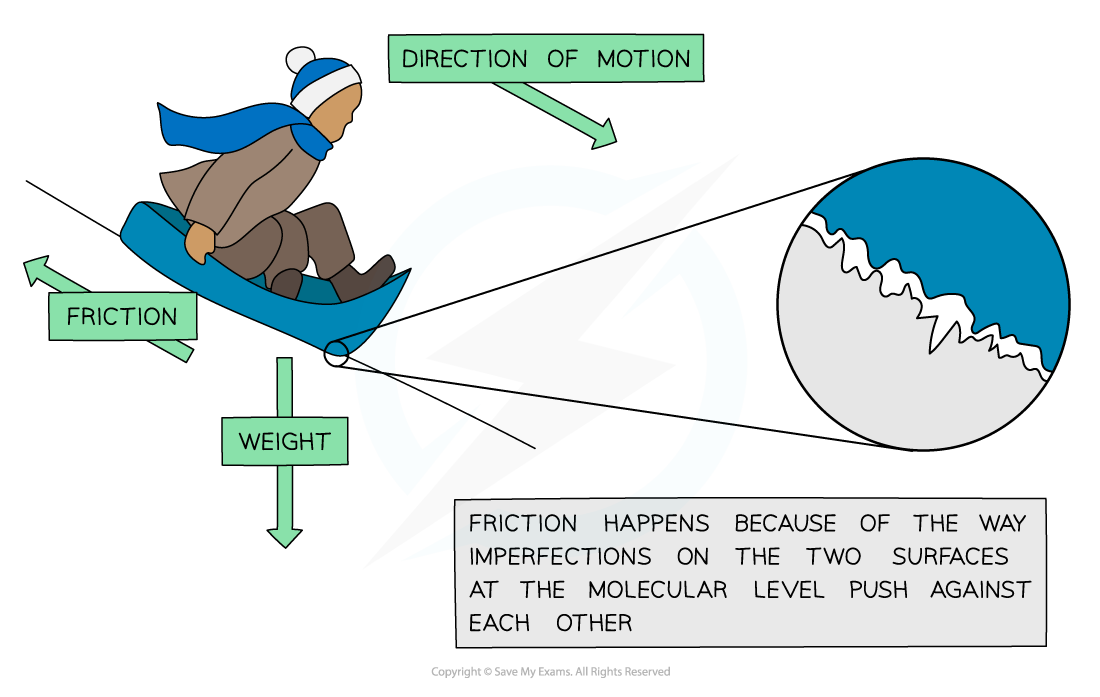
The interface between the ground and the sled is bumpy which is the source of the frictional force
Static & Dynamic Friction
- There are two kinds of friction to consider for IB DP Physics
- Static friction?occurs when two solid objects are in contact and?no movement?is occurring between the two objects
- Dynamic friction?occurs once one of the objects is?moving?past the other, such as in the sled example above
- Both of these forms of friction depend on the?normal reaction force?of the object sitting upon the other
- Static friction will?match?any pushing force that acts against until it can no longer hold the two objects stationary
- Static friction?increases?in magnitude?until movement begins?and dynamic friction occurs
- For any given situation,?static friction?should reach a maximum value that is?larger?than that of?dynamic friction
- For a constant pushing force,?dynamic?friction will be a?constant
- This is because there are more forces at work keeping an object stationary than there are forces working to resist an object once it is in motion
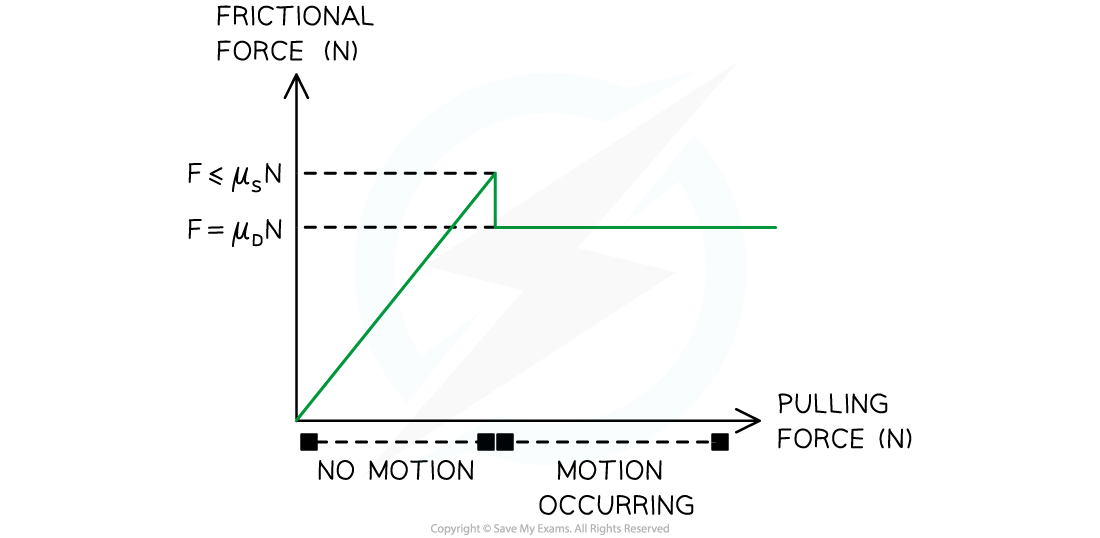
The relationship between frictional forces and motion
- The equation for static friction is given by:
F ≤?μS?× R
- Where:
- F?= static frictional force (N)
- μS?= coefficient of static friction
- R?= normal reaction force (N)
- The?coefficient?of static?friction?is a number between 0 and 1 but does not include those numbers
- It is a ratio of the force of static friction and the normal force
- The?larger?the coefficient of static friction, the?harder?it is to move those two objects past one another
- The equation for dynamic friction is given by:
F =?μD?× R
- Where:
- F?= dynamic frictional force (N)
- μD?= coefficient of dynamic friction
- R?= normal reaction force (N)
- The coefficient of dynamic friction has similar properties to that of static friction
- Yet,?dynamic friction?has a?definite force?value for a given situation
- Whereas the force of?static friction?has an?increasing force?value
Worked Example
An 8.0 kg block sits on an incline of 20 degrees from the horizontal. It is stationary and does have a frictional force acting upon it. Determine the minimum possible value of the coefficient of static friction.
Step 1: List the known quantities
-
- Mass of the block,?m?= 8.0 kg
- Angle between the slope and the horizontal, θ = 20°
Step 2: Determine the weight of the block
-
- The weight will act directly downwards and comes from the interaction of mass and acceleration due to gravity
W?=?m?×?g
8.0 × 9.8 = 78.4 N downwards
Step 3: Break the weight down into components based on the slope angle
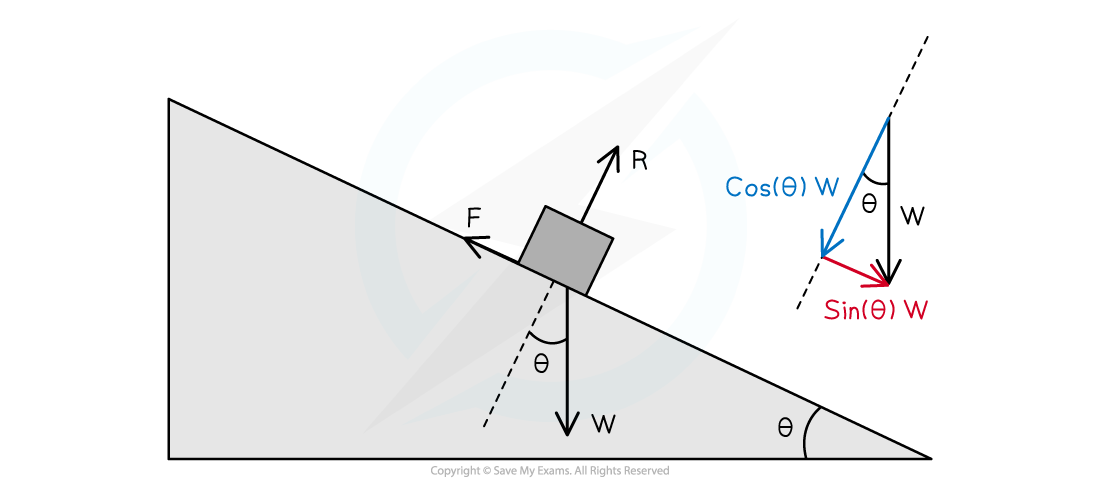
-
- The component that is parallel to the slope and provides a force moving the block down the slope can be found from:
sin(20°) ×?W = F
F = sin(20°) × 78.4 = 26.8 N
-
- The component that is perpendicular to the slope and the same magnitude as the normal reaction force can be found from:
cos(20°) ×?W = F
F = cos(20°) × 78.4 = 73.7 N
Step 4: Use the equation of static friction to find the minimum value of the coefficient of static friction
-
- The equation for static friction is:
F ≤μS?× R
-
- In this case, the?F?is the 26.8 N pushing the block down the slope
- The?Ris the normal reaction force which has the same magnitude as the perpendicular component of the weight force which is 73.7 N
- Therefore the value can be added and?μS?solved for:
26.8 ≤μS?× 73.7
-
- Rearrange for?μS
26.8 ÷ 73.7 ≤μS
0.36 ≤μS
Step 5: State the final answer
-
- The coefficient for static friction must be at least?0.36 or greater?for this situation
轉(zhuǎn)載自savemyexams
以上就是關于【IB DP Physics: HL復習筆記2.2.6 Friction】的解答,如需了解學校/賽事/課程動態(tài),可至翰林教育官網(wǎng)獲取更多信息。
往期文章閱讀推薦:
MIT官方發(fā)布【2026年夏季推薦閱讀書單】!橫跨科學/人文/經(jīng)濟...


翰林AMC8視頻課重磅上線!

國際競賽真題資源免費領取






