IB DP Chemistry: HL復習筆記14.2.2 Ozone Revisited

Ozone Revisited
- We have seen previously that ozone is a molecule with two resonance structures leading to a resonance hybrid

The two Lewis resonance structures for ozone
- The central oxygen atom has three electron?domains?and a lone pair, so the domain geometry is triangular planar and the molecular geometry is bent linear
- The presence of the lone pair repels the bonding pairs more strongly so the bond angle is reduced to 117o

The molecular structure of ozone
- The bond order for each bond in ozone is
bond order in O3?= total number of O3?bonding pairs ÷ total number of positions = 3 ÷ 2 =?1.5
- This gives a polar molecule with bonds that are weaker than the double bond in oxygen molecules

The structure of oxygen and ozone
- You would expect O-O bonds to be non-polar as the atoms have the same electronegativity; this is correct, but overall the molecule is polar due to the uneven distribution of electron cloud charge
- The formal charge on the Lewis structures show that the electrons are unevenly distributed
FC= (number of valence electrons) – ?(number of bonding electrons) – (number of non-bonding electrons)
FC (oxygen A) = (6) - ?(2) - (6) = -1
FC (oxygen B) = (6) - ?(6) - (2) = +1
FC (oxygen C) = (6) - ?(4) - (4) = 0
Formal charges on the oxygens in ozone
Catalytic Depletion
- The bonding and structure of ozone is key to understanding how the catalytic depletion of ozone occurs in the stratosphere
- ?High energy UV radiation in the stratosphere breaks the oxygen-oxygen double bond creating oxygen atoms
O2?(g) → O? (g) + O? (g) ?H?+ve, UV light, λ < 242 nm
- These oxygen atoms have unpaired electrons- they are known as?free radicals
- The free radicals are highly reactive and quickly attack oxygen molecules forming ozone in an exothermic reaction, which raises the temperature of the stratosphere
OZONE FORMATION? ? ? ? ?O? (g) + O2?(g) → O3?(g) ?H?– ve
- Ozone requires less energy to break than oxygen
- It produces an oxygen molecule and an oxygen free radical:
OZONE DEPLETION? ? ? ? ? O3?(g) → O? (g) + O2?(g) ?H?+ve, UV light, λ< 330 nm
- The radical reacts with another ozone molecule making two molecules of oxygen in an exothermic reaction
OZONE DEPLETION? ? ? ? ?O3?(g) + O? (g) → 2O2?(g) ?H?– ve
- The temperature in the stratosphere is maintained by the balance of ozone formation and ozone depletion in a process known as the Chapman Cycle
- It is not a closed system as matter and energy flow in and out, but it is what is called a steady state
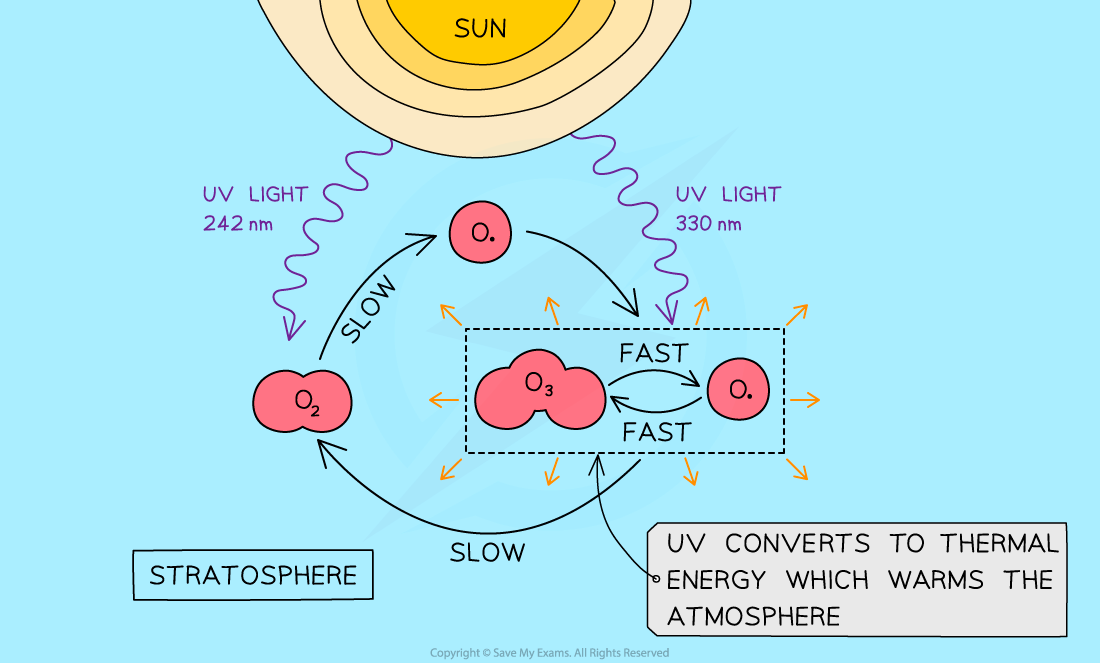
The Chapman cycle
Catalytic Depletion
- The two main man made culprits that accelerate the depletion of ozone are?nitrogen oxides?and?CFCs
- Nitrogen monoxide, NO, is produced from the high temperatures inside internal combustion engines
- If you count the valence electrons in nitrogen monoxide (5 + 6 =11), the odd number tells you it is a?free radical?as it has an unpaired electron
- The nitrogen monoxide reacts with ozone forming oxygen and a nitrogen dioxide radical
NO? (g) + O3?(g) → NO2? (g) + O2?(g)
- The nitrogen dioxide produced is also a free radical (it has 5 + 6 + 6= 17 electrons)
NO2? (g) + O? (g) → NO? (g) + O2?(g)
- The nitrogen monoxide is regenerated so it has a catalytic role in the process
- Combining the two equations and cancelling out the NO? and NO2? and you arrive at the overall depletion of ozone
O3?(g) + O? (g) → 2O2?(g)
- A similar process happens with CFCs
- The C-Cl bond in the CFCs is weaker than the C-F bond and breaks more easily in the presence of UV light creating chlorine radicals
CCl2F2?(g) + UV → CClF2? (g) + Cl? (g)
- The chlorine radicals attack ozone and are regenerated at the end of the cycle
Cl? (g) + O3?(g) → ClO? (g) + O2?(g)
ClO? (g) + O? (g) → Cl? (g) + O2?(g)
- Once again a molecule of ozone has been destroyed by a catalytic free radical
- The net effect of these reactions is that these pollutants have created an imbalance in the natural ozone cycle leading to an overall depletion in stratospheric ozone
- CFCs?are greatly damaging to stratospheric ozone and have been largely replaced by safer alternatives following the 1985 Montreal Protocol
- The depletion of ozone has allowed greater amounts of harmful?UV light?to reach the surface of the Earth
- UV light?has been linked to greater incidence of skin cancer and cataracts as well as the destruction of phytoplankton and reduced plant growth
轉載自savemyexams
以上就是關于【IB DP Chemistry: HL復習筆記14.2.2 Ozone Revisited】的解答,如需了解學校/賽事/課程動態,可至翰林教育官網獲取更多信息。
往期文章閱讀推薦:
MIT官方發布【2026年夏季推薦閱讀書單】!橫跨科學/人文/經濟...


翰林AMC8視頻課重磅上線!

國際競賽真題資源免費領取






