IB DP Chemistry: HL復習筆記13.1.2 Variable Oxidation States

Variable Oxidation States
- When transition elements forms ions they lose electrons from the?4s?subshell first
- This is because when the orbitals are occupied, the repulsion between electrons pushes the?4s?into a higher energy state so that it now becomes slightly higher in energy than the?3d?subshell
- The?4s?is now the outer shell and loses electrons first
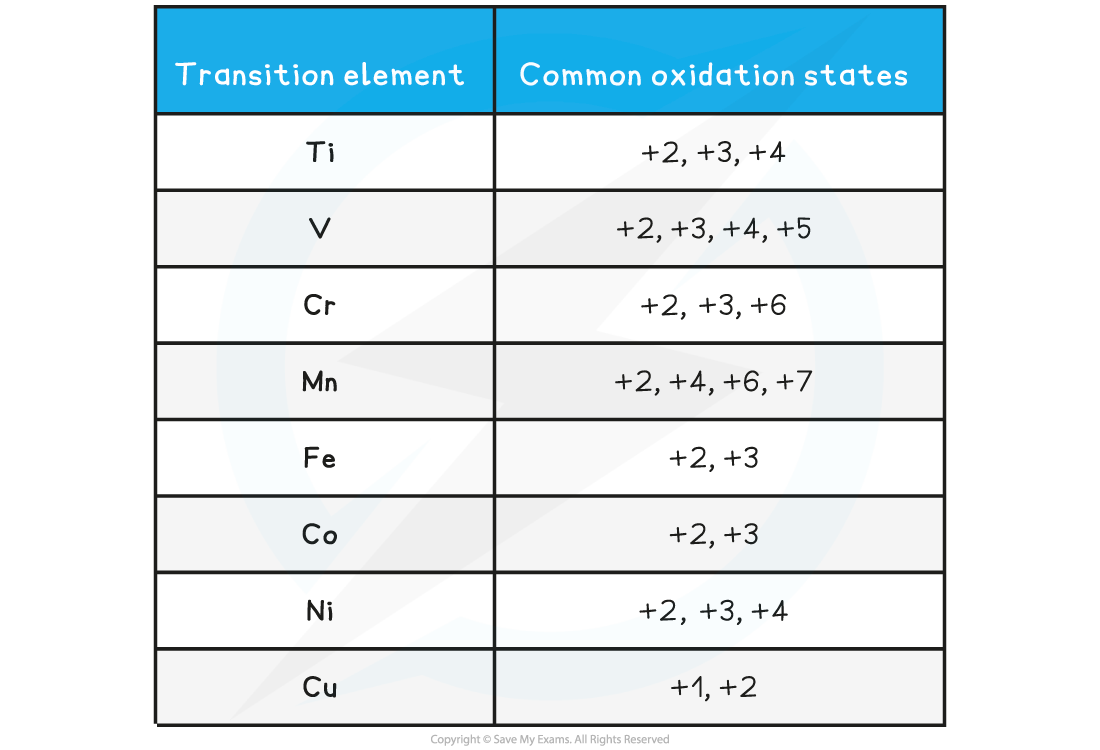
- The loss of the?4s?electrons means that?+2?is a common?oxidation state?in transition metals
- The reason why the transition metals have variable oxidation states all comes down to energy
Table showing the the common oxidation states of transition elements
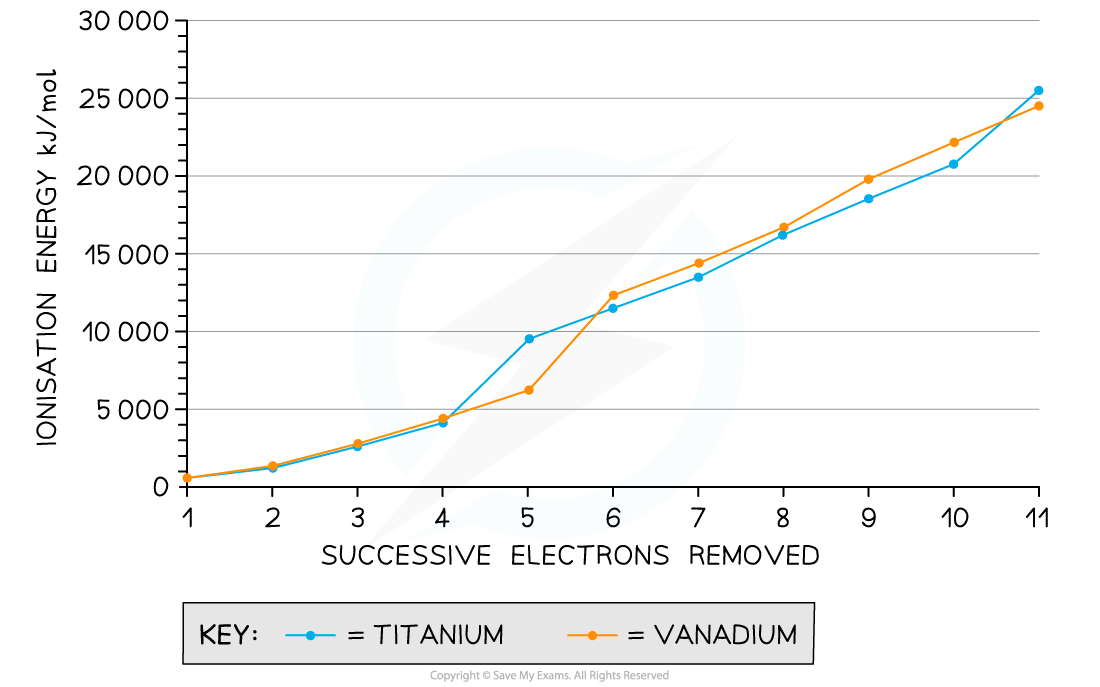
Ionisation?energies for the removal of successive electrons in titanium and vanadium
- We can see from the graph that the first few?ionisation energies?are relatively small and relatively close together
- This means that the energy difference associated with removing a small number of electrons enables transition metals to vary their oxidation state with ease
- The +2 and +3 oxidation state is shown by all the transition elements although the +3 state is more stable up to chromium and the +2 state more stable in the later elements
- Transition metal ions with oxidation state +3 and above tend to be?polarising?and have a degree of covalent character in the bonds they form. The ions have a?high charge density?and pull electrons towards themselves
- The maximum oxidation state possible corresponds the total number of electrons in the 4s and 3d which reaches a maximum at manganese
- An example you may be familiar with is the manganate(VII) ion, MnO4-?which is a powerful oxidising agent
Exam Tip
Common oxidation charges on transition metal ions are given in section 9 of the data booklet, and common oxidation states are given in section 14.
轉載自savemyexams
以上就是關于【IB DP Chemistry: HL復習筆記13.1.2 Variable Oxidation States】的解答,如需了解學校/賽事/課程動態,可至翰林教育官網獲取更多信息。
往期文章閱讀推薦:
MIT官方發布【2026年夏季推薦閱讀書單】!橫跨科學/人文/經濟...


翰林AMC8視頻課重磅上線!

國際競賽真題資源免費領取






