IB DP Chemistry: HL復習筆記4.1.6 Lewis Structures

Lewis Structures
- Lewis structures?are simplified electron shell diagrams and show pairs of electrons around atoms.
- A pair of electrons can be represented by dots, crosses, a combination of dots and crosses or by a line. For example, chlorine can be shown as:

Different Lewis Structures for chlorine molecules
- Note: Cl–Cl is not a?Lewis structure, since it does not show all the electron pairs.
- The “octet rule” refers to the tendency of atoms to gain a valence shell with a total of 8 electrons
Steps for drawing Lewis Structures
-
- Count the total number of?valence
- Draw the?skeletal structure?to show how many atoms are linked to each other.
- Use a pair of crosses or dot/cross to put an electron pair in each bond between the atoms.
- Add more electron pairs to complete the octets around the atoms ( except H which has 2 electrons)
- If there are not enough electrons to complete the octets, form double/triple bonds.
- Check the total number of electrons in the finished structure is equal to the total number of?valence?electrons
Worked Example
Draw a Lewis structure for CCl4
Answer:
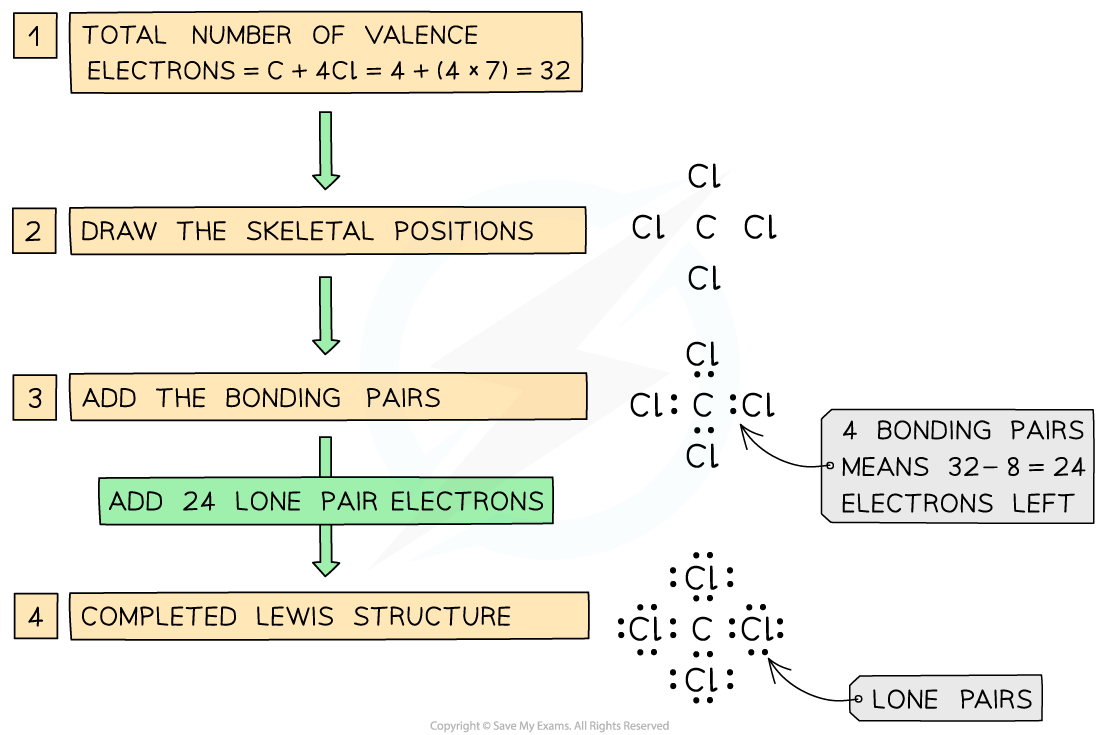
Steps in drawing the Lewis Structure for CCl4
Further examples of Lewis structures
- Follow the steps for drawing Lewis structures for these common molecules
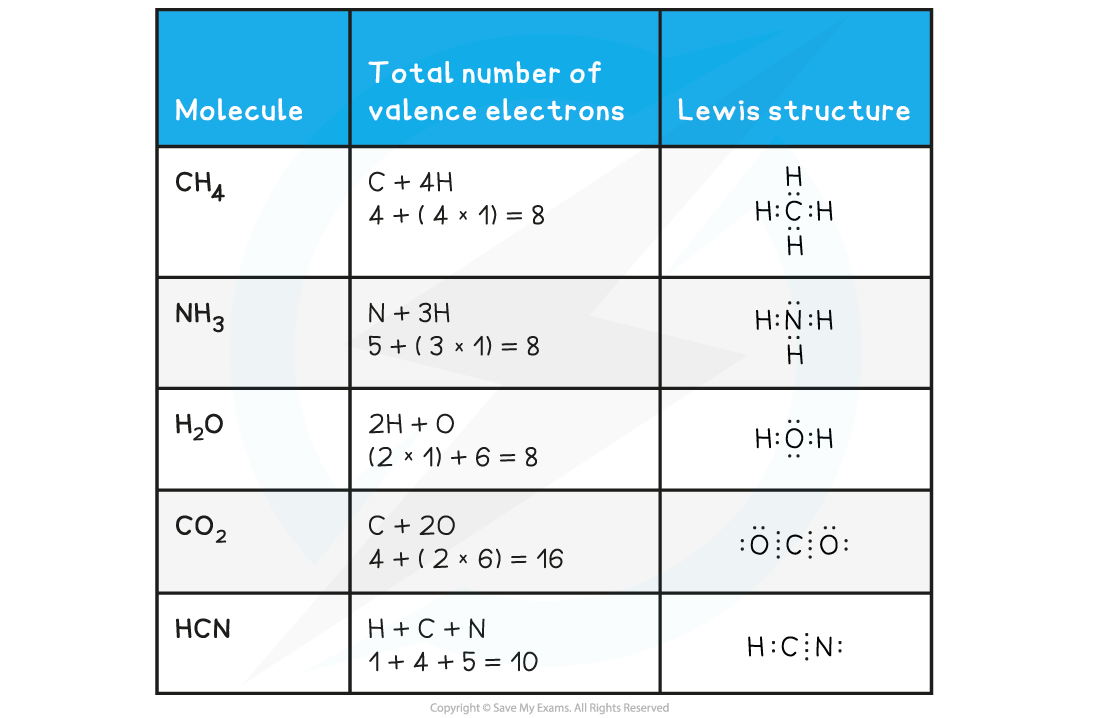
Incomplete Octets
- For elements below atomic number 20 the?octet rule?states that the atoms try to achieve 8 electrons in their valence shells, so they have the same electron configuration as a noble gas
- However, there are some elements that are exceptions to the?octet rule, such a H, Li, Be, B and Al
- H can achieve a stable arrangement by gaining an electron to become 1s2, the same structure as the noble gas helium
- Li does the same, but losing an electron and going from 1s22s1?to 1s2?to become a Li+?ion
- Be from group 2, has two valence electrons and forms stable compounds with just four electrons in the?valence shell
- B and Al in group 13 have 3 valence electrons and can form stable compounds with only 6 valence electrons
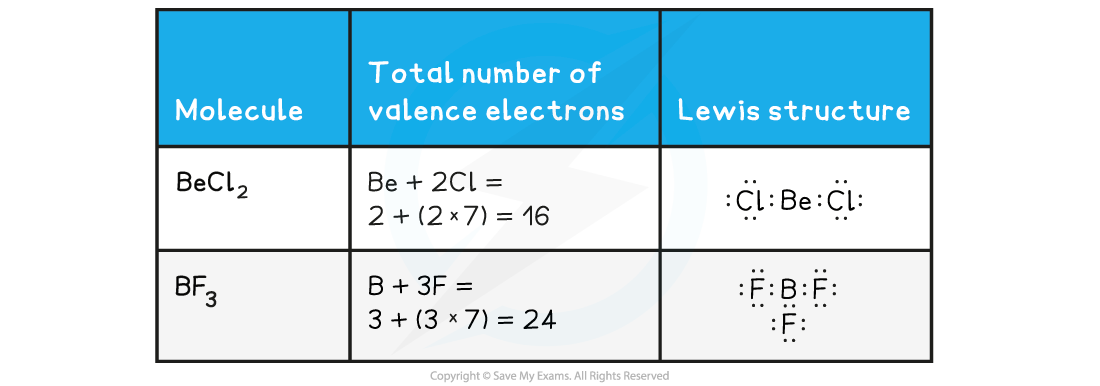
- There are two examples of?Lewis structures?with incomplete octets you should know, BeCl2?and BF3:
Incomplete Octets Examples
- Test your understanding of Lewis diagrams in the following example:
Worked Example
How many electrons are in the 2-aminoethanoic acid molecule?
A.? 18
B.? 20
C.? 28
D.? 30
Answer:
The correct option is?D.
-
- You must count the lone pairs on N and O as well as the bonding pairs. There are 5 ‘hidden’ pairs of bonding electrons in the OH, CH2?and NH2?groups. Hydrogen does not follow the octet rule.
轉載自savemyexams
以上就是關于【IB DP Chemistry: HL復習筆記4.1.6 Lewis Structures】的解答,如需了解學校/賽事/課程動態,可至翰林教育官網獲取更多信息。
往期文章閱讀推薦:
MIT官方發布【2026年夏季推薦閱讀書單】!橫跨科學/人文/經濟...


翰林AMC8視頻課重磅上線!

國際競賽真題資源免費領取






