IB DP Biology: HL復習筆記11.3.1 Osmoregulation in Organisms

Organisms & Osmolarity in the Environment
- Living organisms need to maintain a?safe balance of water and?solutes?in their cells
- Failure to maintain this balance will mean that an organism's cells could either?take on water and burst, or?lose water and shrink?due to the effects of?osmosis
- Cells with a?higher?osmolarity?than their surrounding environment?will?gain water by osmosis?and the resulting internal pressure increase could cause the cell to?burst
- Note that plant cells are protected from bursting by their?strong cell walls
- Cells with a?lower osmolarity?than their surrounding environment?will?lose water by osmosis?and the resulting drop in internal pressure will cause the cell to?shrink
- Cells with a?higher?osmolarity?than their surrounding environment?will?gain water by osmosis?and the resulting internal pressure increase could cause the cell to?burst
- Organisms avoid the cell damage that can result from water gain or loss by either?osmoconforming?or?osmoregulating
- Osmoconforming means that the?osmolarity of an organism's body fluids matches that of its surroundings
- Examples of osmoconformers include?marine invertebrates?such as mussels, lobsters, and jellyfish, as well as some?unusual groups of fish?such as sharks and hagfish
- Osmoconforming is achieved by?retaining ions from the environment in the body fluids, or in the case of sharks by retaining the urea produced in metabolism
- Some osmoconformers have the ability to?change their internal osmolarity over a large range?when their environment changes
- Osmoregulation means?maintaining a constant body fluid osmolarity regardless of the osmolarity of the external environment
- Examples of osmoregulators include?land animals,?marine mammals,?most fish, and?amoebas?(singled-celled eukaryotes)
- Amoebas use an organelle called a contractile vacuole to carry out osmoregulation; as the cell takes on water by osmosis, the water moves into the contractile vacuole, which then moves to cell surface membrane, fuses with it, and releases its contents outside the cell
- Osmoregulators must?balance retention of water?with the?concentration of other molecules?in their body fluids, such as?sugars, salts, and?amino acids
- Examples of osmoregulators include?land animals,?marine mammals,?most fish, and?amoebas?(singled-celled eukaryotes)
- Osmoconforming means that the?osmolarity of an organism's body fluids matches that of its surroundings
The Malpighian Tubule System
- Osmoregulation?is the process by which the?balance of water and solutes in the body fluids?of an organism is?maintained
- In vertebrates osmoregulation is carried out by?kidneys
- Kidneys remove?nitrogenous waste?as well as any unwanted?sugars?and?salts?from the blood
- Nitrogenous waste is produced when there are?excess amino acids?present after the digestion of dietary?protein
- Amino acids?cannot be stored, so are converted first to toxic ammonia, then to a less toxic form; in humans this is?urea, while some other animals e.g. birds and insects produce?uric acid
- The urea or uric acid can then be safely excreted from the body
- Kidneys remove?nitrogenous waste?as well as any unwanted?sugars?and?salts?from the blood
Osmoregulation in insects
- Insects that live on land osmoregulate using a specialised system of?malpighian tubules
- Malpighian tubules are?a series of small tubes?that extend?from the body cavity?and drain?into?the insect's digestive system
- Insects do not technically have blood but instead have a fluid known as?haemolymph?within the body cavity?which?surrounds the internal organs
- The malpighian tubule system removes?nitrogenous waste,?salts,?and?water?from the haemolymph, enabling the excretion of nitrogenous waste in the form of?uric acid
- The tubules are lined with cells that?actively transport ions?such as sodium (Na+) and potassium (K+) from the haemolymph into the tubule lumen,?raising the osmolarity?and?altering the charge?of the lumen contents
- Water moves?into the lumen from the haemolymph by?osmosis
- Nitrogenous waste enters the tubules?from the haemolymph along an electrical gradient
- The ions, water, and nitrogenous waste drain from the malpighian tubules into the digestive system
- Nitrogenous waste is converted into?uric acid
- Useful salts and water are reabsorbed?from the hindgut into the haemolymph
- Uric acid remains in the digestive system, from which it later leaves the body?along with faeces
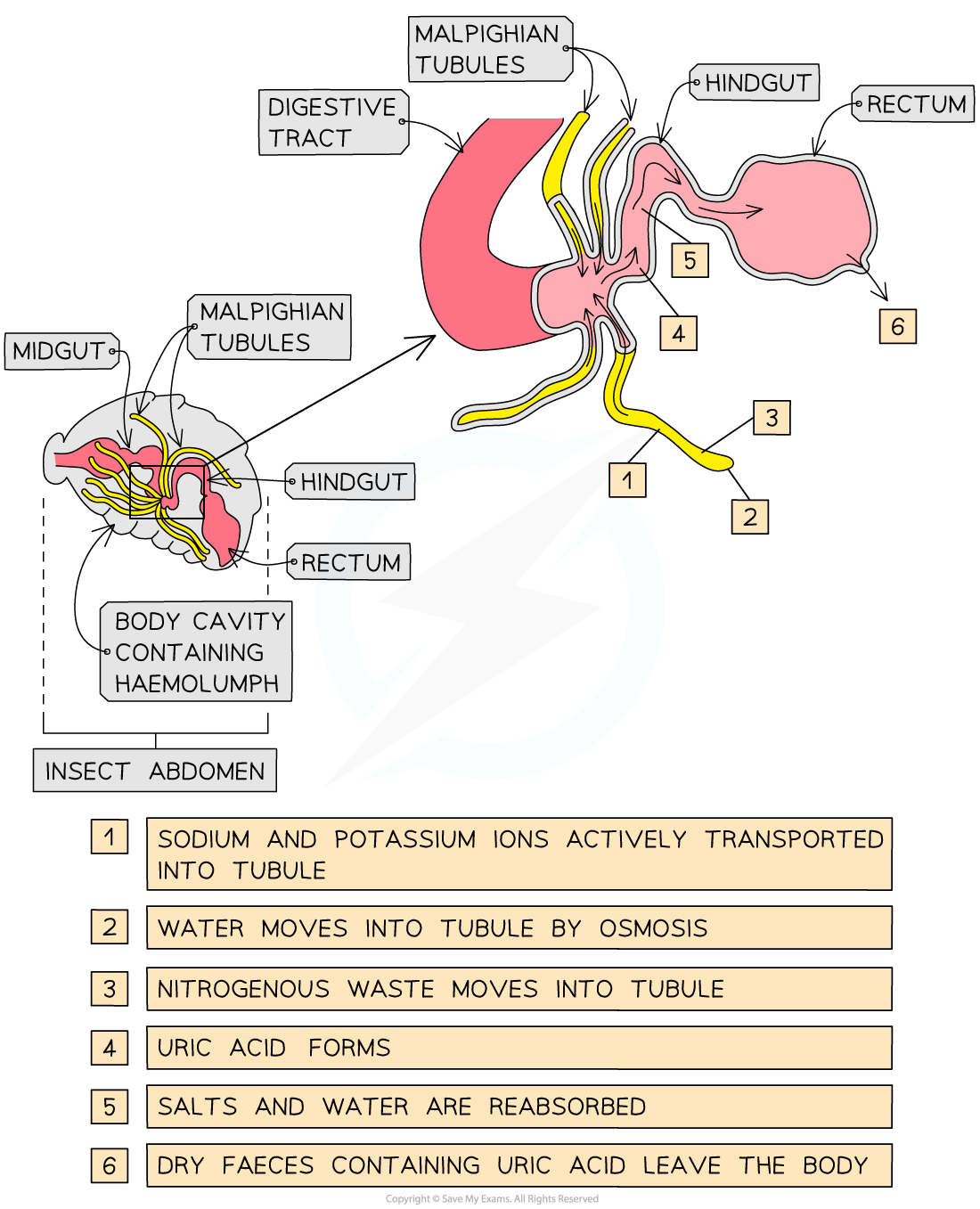
Terrestrial insects use the malpighian tubule system to remove nitrogenous waste from their bodies in the form of uric acid
Exam Tip
Don't get too bogged down in the exact details of the processes taking place inside the Malpighian tubules, just make sure that you can outline the events e.g.
- Small molecules such as salts and nitrogenous waste are actively transported from the haemolymph into the malpighian tubules
- Water follows by osmosis
- The malpighian tubules drain into the insect's digestive tract
- Useful substances such as salts and water are reabsorbed from the gut, while uric acid is excreted
Blood Composition in the Renal Blood Vessels
- The kidneys have two important roles in the human body
- They?remove the toxic products of metabolism?from the blood
- They?maintain the balance of water and solutes?in the blood
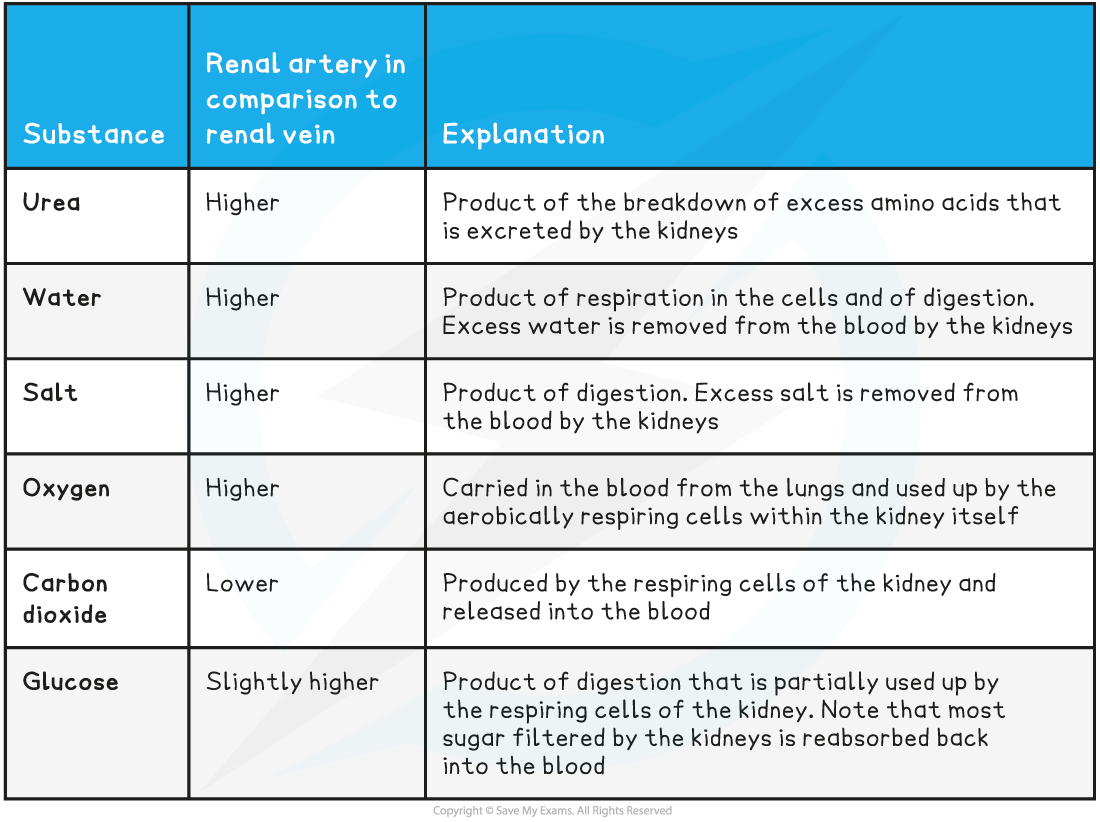
- Blood enters the kidney from the body through the?renal artery?and leaves the kidney to return to the body in the?renal vein
- The?composition of the blood changes?as it passes through the kidneys due to
- The removal of waste
- The adjustment of the balance of solutes and water
- Respiration taking place in the cells of the kidney
- The blood?entering the kidney via the renal artery?therefore has a?different composition?to the blood?leaving the kidney via the renal vein
Blood composition in the renal blood vessels table
轉載自savemyexams
以上就是關于【IB DP Biology: HL復習筆記11.3.1 Osmoregulation in Organisms】的解答,如需了解學校/賽事/課程動態,可至翰林教育官網獲取更多信息。
往期文章閱讀推薦:
MIT官方發布【2026年夏季推薦閱讀書單】!橫跨科學/人文/經濟...


翰林AMC8視頻課重磅上線!

國際競賽真題資源免費領取






