IB DP Biology: HL復(fù)習(xí)筆記9.4.2 Plant Reproduction

Mutualism Between Flowers & Pollinators
- Sexual?reproduction in plants requires the?transfer of pollen?between flowers
- Methods of pollen transfer can include:
- Wind
- Animals
- Water
- Most flowering plants use?mutualistic relationships?with animal?pollinators?in sexual reproduction
- The pollinator visits the flower to obtain food, often in the form of?nectar,?from the plant
- Pollinating animals can be insects, birds, or small mammals such as bats
- Pollen sticks?to the body of the animal and is subsequently?transferred to the flowers of the next plant?visited by the pollinator
- It is a?mutualistic?relationship because?both organisms gain?a benefit during the process
- Mutualism is a type of?symbiotic?relationship
- The pollinator visits the flower to obtain food, often in the form of?nectar,?from the plant
Pollination, Fertilisation & Seed Dispersal
Introduction to Flower Structure
- The development of flowers occurs in the?reproductive stage?of the plant life cycle
- Flowers contain all the necessary organs and tissues required for?sexual reproduction?by?pollination
- Key structures of the flower include
- The?anther?- where the male gamete, pollen, is found
- The?stigma?- part of the female reproductive organ which receives the pollen
- The?ovary?- where the female gametes are located
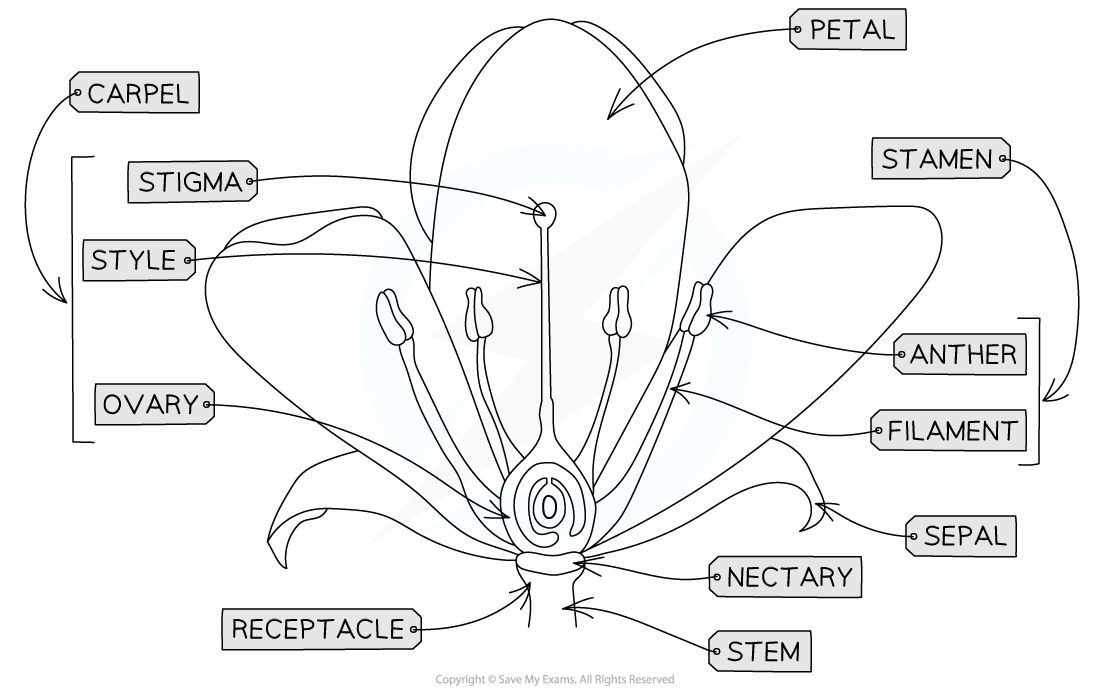
Animal pollinated flowers have structures that attract pollinators and aid the process of pollination
Pollination and Fertilisation
- Pollination?is the process of transferring pollen from the?anther?of one flower to the?stigma?of another
- Self pollination?can occur in some species when pollen is transferred between different flowers on the same plant, or even from anther to stigma within the same flower
- After pollination has occurred, a?pollen tube?grows from the?pollen grain?down the?style?to the?ovary?of the plant
- The?male nuclei?travel down the pollen tube to the female ovule
- Two male nuclei travel down the pollen tube to the ovule; one will fuse with an ovule nucleus to form the zygote while the other will go on the form the plant embryo's food store
- Fertilisation?occurs when the?haploid?male and female nuclei fuse and a?diploid zygote?is formed
- After fertilisation, the?ovule?becomes a?seed?and the?ovary?develops into the?fruit
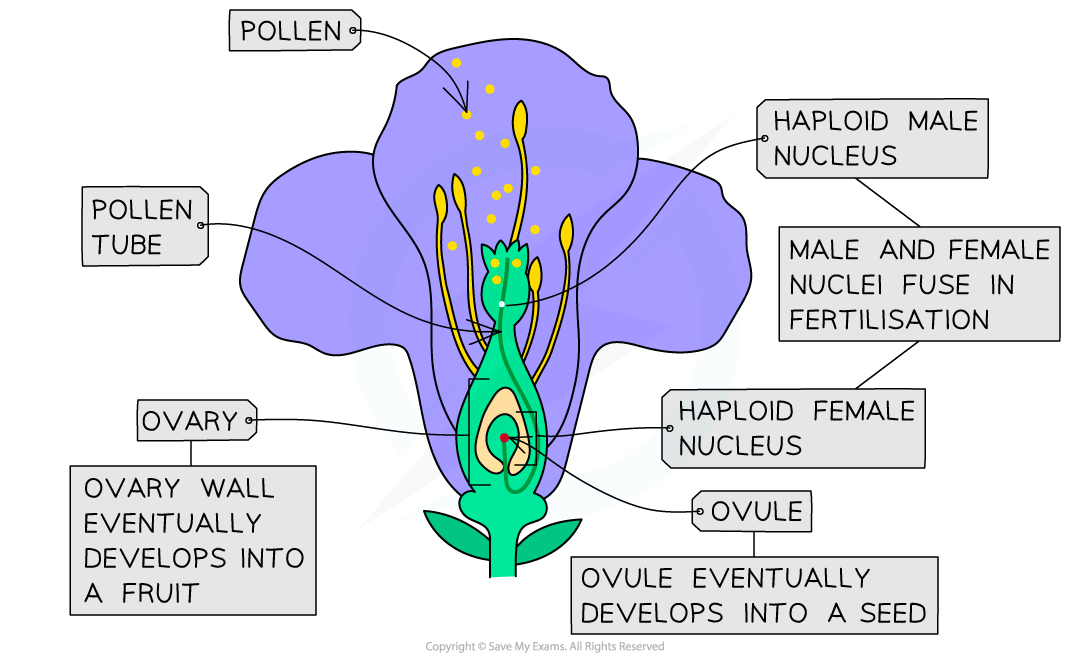
After pollination the haploid male and female nuclei can fuse in fertilisation to make a diploid zygote
Seed Dispersal
- Seed dispersal?is then required in order to distribute the seeds away from the parent plant and?reduce competition?between the offspring and the parent plant
- Methods of seed dispersal include
- Wind or water
- Parachute or wing shaped lightweight seeds will travel on the wind or float in water
- Animals
- Fleshy fruit is eaten by animals and seeds distributed through egestion
- Sticky or hooked seeds catch on to the fur or feathers of passing animals
- Explosions
- Some pods explode propelling the seeds away from the parent plant
- Wind or water
- Methods of seed dispersal include
Exam Tip
Be careful not to mix up pollination and seed dispersal; pollination is the?transfer of pollen from anther to stigma, while seed dispersal is the?distribution of mature seeds. Both processes can involve wind, water, or animals.
Protecting Pollinators
NOS: Paradigm Shift; more than 85% of the world’s 250,000 species of flowering plant depend on pollinators for reproduction. This knowledge has led to protecting entire ecosystems rather than individual species
- Paradigm shifts occurs when?frameworks underlying scientific thinking?change due to e.g.
- Discovery of?new knowledge
- Developing understanding
- Updating processes as a result of changed knowledge and understanding can allow progression towards more?successful approaches?in science
- A shift in the approach to conservation is an example of this:
- Early efforts in conservation were primarily focused on?protecting individual species?or?populations?which were under threat
- However, whilst it is still essential to promote the maintenance of animal populations over time, it has become apparent that the?relationships between species and the ecosystems in which they live?are?just as fundamental, if not more so
- With this in mind, it is important to?conserve habitats?and the?ecological processes?relied on by the communities within those habitats
- The?role of pollinators?is a key example of a?relationship between species and ecosystem?where changes in the process of pollination could have huge impacts on the wider ecosystem
- Pollinators directly support the survival of plant species?with which they interact, and also?indirectly impact the other species?within the associated community
- Loss of either pollinator or plant species could cause an ecosystem to break down, leading to huge?biodiversity?losses
- Pollinators play a huge role in the?production of crops?and therefore are relied upon by the farmers growing those crops for an income, but also by the consumers of the crops who require affordable and good quality food sources
- Pollinators directly support the survival of plant species?with which they interact, and also?indirectly impact the other species?within the associated community
轉(zhuǎn)載自savemyexams
以上就是關(guān)于【IB DP Biology: HL復(fù)習(xí)筆記9.4.2 Plant Reproduction】的解答,如需了解學(xué)校/賽事/課程動態(tài),可至翰林教育官網(wǎng)獲取更多信息。
往期文章閱讀推薦:
斯坦福大學(xué)官方推薦書單!名校學(xué)霸們暑假都在讀什么?
MIT官方發(fā)布【2026年夏季推薦閱讀書單】!橫跨科學(xué)/人文/經(jīng)濟(jì)...


翰林AMC8視頻課重磅上線!

國際競賽真題資源免費領(lǐng)取






