IB DP Biology: HL復(fù)習(xí)筆記6.4.2 Ventilation: Mechanism

Inspiration & Expiration
Breathing in
- The breathing-in, or?inspiration, process causes the?volume of the chest to increase?and the?air pressure to decrease?until it is?lower than the atmospheric pressure
- When gas is in a large-volume container that allows the gas particles to spread out, the pressure exerted by the gas on the walls of the container is low
- As a result, air moves?down the pressure gradient?and rushes into the lungs
- A gas will always move down a pressure gradient from an area of high pressure to an area of low pressure
- The inspiration process
- The?diaphragm?contracts?and?flattens, increasing chest volume
- In addition to the flattening of the diaphragm the?external?intercostal muscles?contract, causing the ribcage to move?upwards?and?outwards; this also increases chest volume
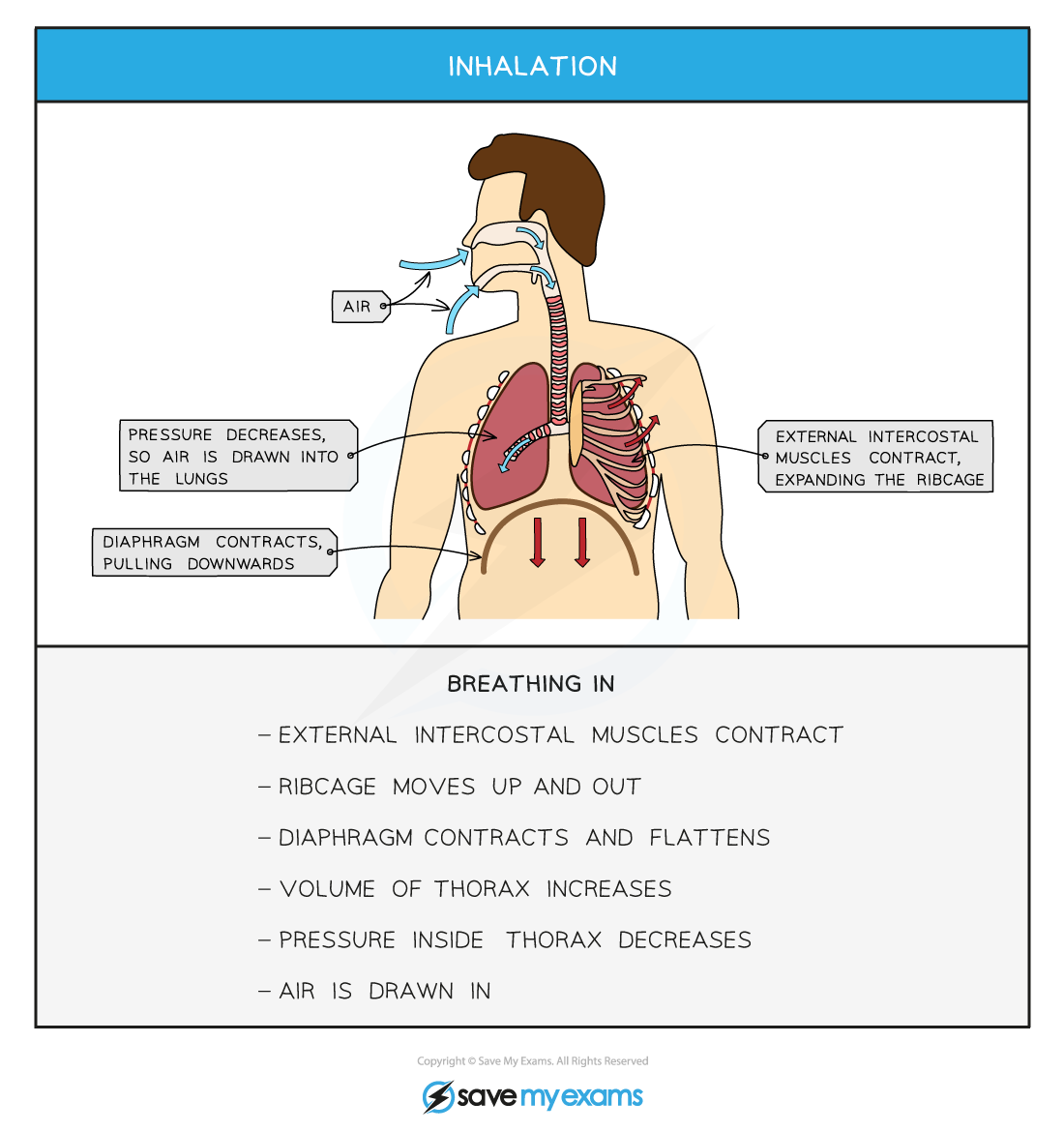
The process of inspiration
Breathing out
- Breathing out, or?expiration, occurs mostly due to the recoil of the lungs after they have been stretched by the inspiration process, and is therefore a mainly passive process
- Volume of the chest decreases?and?pressure increases, causing air to be forced out down its?pressure gradient
- When gas is in a low-volume container it is compressed, causing the gas particles to exert more pressure on the walls of the container
- The passive expiration process
- External intercostal muscles?relax,?allowing the ribcage to move?down?and?in
- Diaphragm?relaxes?and becomes?dome-shaped
- The?recoil?of?elastic fibres?in the alveoli walls reduces the volume of the lungs
- The expiration process can be active when there is a need to expel excess air from the lungs e.g. when blowing out a candle
- The active expiration process
- Internal?intercostal muscles?contract?to pull the ribs?down?and?in
- Abdominal muscles contract?to push organs upwards against the diaphragm, decreasing the volume of the chest cavity
- This causes forced exhalation
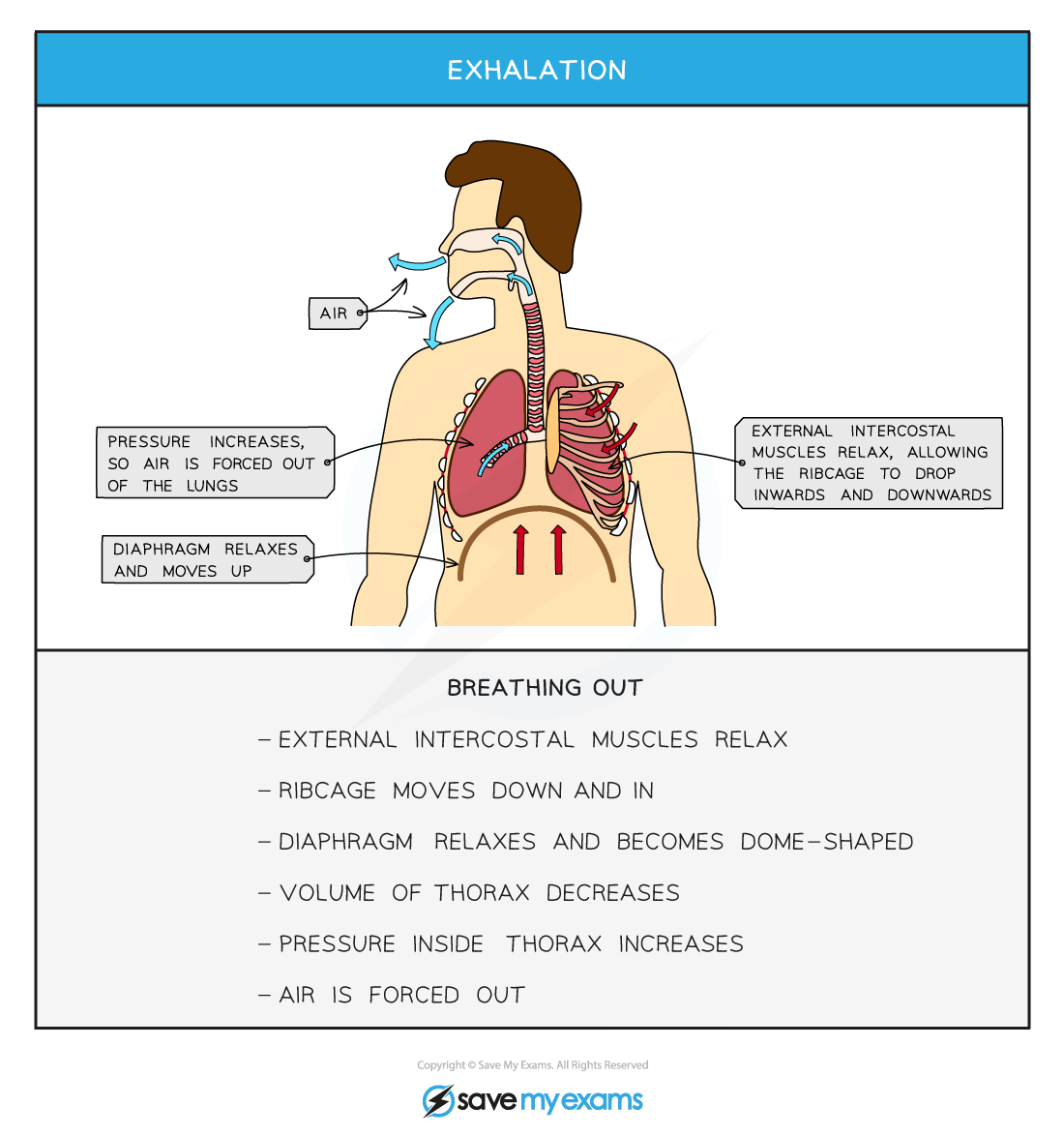
The process of passive expiration
Antagonistic Muscle Action
- Muscles only carry out the work of moving the body when they are?contracting, or?pulling;?they cannot push
- As a result of this limitation muscles often operate in?pairs?when movement in two directions in required
- One muscle of the pair pulls in one direction and the other muscle?pulls in the opposite direction
- This is described as?antagonistic?muscle action
- Examples of antagonistic muscle action in ventilation are
- Internal?and?external intercostal muscles
- When the internal intercostal muscles contract, the rib cage moves down and in
- When the external intercostal muscles contract, the rib cage moves up and out
- The?diaphragm?and?abdominal muscles
- When the diaphragm contracts, it flattens and moves downwards
- When the abdominal muscles contract, the internal organs of the abdomen are compressed and pushed upwards, exerting upward pressure on the diaphragm
- Internal?and?external intercostal muscles
Exam Tip
The intercostal muscles work in an?antagonistic?manner; as one contracts the other relaxes!Note that the internal intercostal muscles only contract to cause?forced expiration; expiration is?passive?the majority of the timeRemember, if you learn one of either inspiration or expiration, the other is almost exactly the opposite.
轉(zhuǎn)載自savemyexams
以上就是關(guān)于【IB DP Biology: HL復(fù)習(xí)筆記6.4.2 Ventilation: Mechanism】的解答,如需了解學(xué)校/賽事/課程動(dòng)態(tài),可至翰林教育官網(wǎng)獲取更多信息。
往期文章閱讀推薦:
斯坦福大學(xué)官方推薦書(shū)單!名校學(xué)霸們暑假都在讀什么?
MIT官方發(fā)布【2026年夏季推薦閱讀書(shū)單】!橫跨科學(xué)/人文/經(jīng)濟(jì)...


翰林AMC8視頻課重磅上線!

國(guó)際競(jìng)賽真題資源免費(fèi)領(lǐng)取






