IB DP Biology: HL復習筆記4.2.4 Carbon Cycle: Organic Matter

Formation of Peat
- Under normal conditions the tissues of dead organisms are completely broken down by decomposers known as?saprotrophs?and?detritivores
- These decomposers require specific conditions, such as?oxygen?availability and the?correct pH
- If ground is?waterlogged?or?acidic, most decomposers cannot survive, and only?partial decomposition?takes place
- Waterlogging occurs when levels of rainfall exceed levels of evaporation
- When ground is waterlogged, the air spaces in the soil is filled with water, and the conditions become?anaerobic
- Low pH can occur due to mineral leaching, acidic bedrock, bacterial activity, and the growth of certain types of plant
- Waterlogging occurs when levels of rainfall exceed levels of evaporation
- Under waterlogged and acidic conditions partly decomposed organic material, such as?dead plant matter, accumulates, and becomes?compacted?under its own weight over time; this compacted, partially decomposed plant matter forms?peat
- The place where peat accumulates is known as a?peat bog, or?peatland
- There are various types of peat bog e.g. blanket bog and raised bog, depending on the landscape and conditions in which it forms
- The?carbon compounds?in plant material are trapped in peat
- Over millions of years, peat can develop into the fossil fuels coal, oil, or natural gas
- Peat is considered to be a valuable resource, and digging up peat bogs has been a common practice
- Peat can be burned as a?fuel?due to its carbon content
- The high nutrient content of peat means that it is often used in?compost
- The importance of peat bogs as a?carbon store?and unique,?biodiverse, habitat?is now better understood, and many people work to protect and restore peat bogs
Exam Tip
Make sure you know that peat is formed from partly decomposed plant matter that results from acidic and waterlogged (anaerobic) conditions.
Fossilisation
- If animals and plants die in?acidic?or?anaerobic?conditions?then?complete?decomposition?cannot take place
- Micro-organisms that carry out decomposition cannot survive in acidic or anaerobic conditions
- The carbon in remaining tissues can be converted into?fossil fuels?over?millions of years?
- This means that carbon taken into the tissues of living organisms during?past geological eras?is locked up in fossil fuels
- Coal?forms when?peat?(see above) that forms in acidic and anaerobic conditions is?buried, compressed,?and?heated e.g. after a rise in sea levels
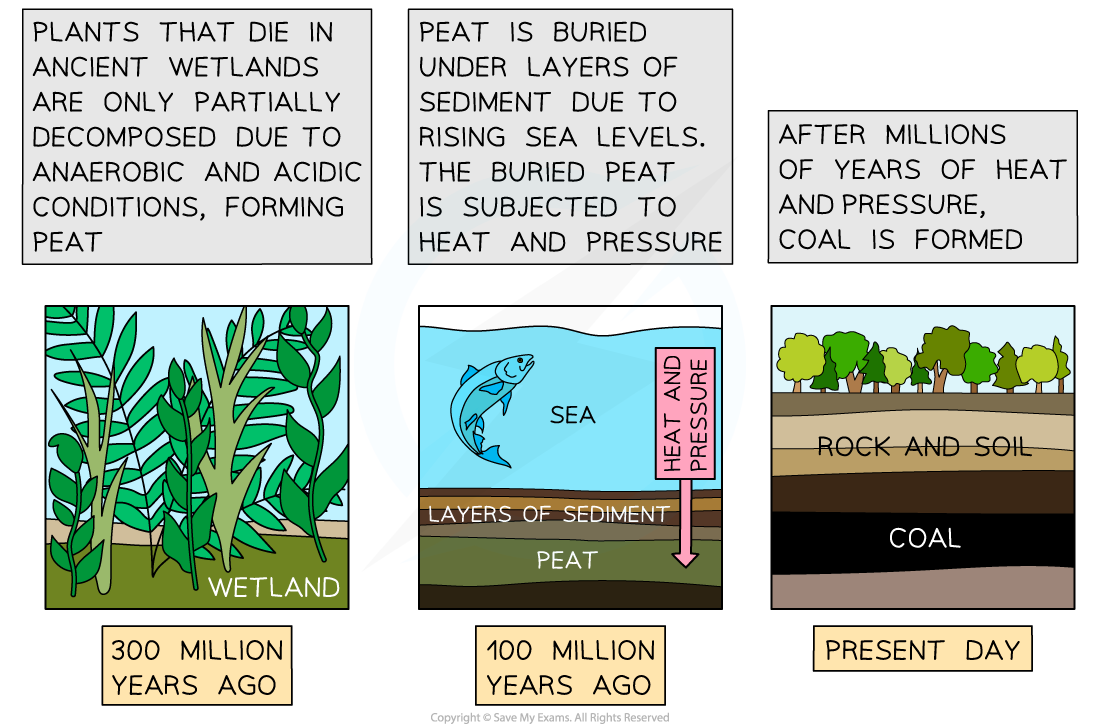
Formation of coal from peat
- Oil?and?natural gas?form in anaerobic conditions at the bottom of seas and lakes when?aquatic organisms?die and are covered by?layers of sediment, and are then?compressed?and?heated.?
- Natural gas forms?deposits?in?porous rock when surrounding non-porous rock prevents it from escaping to the surface
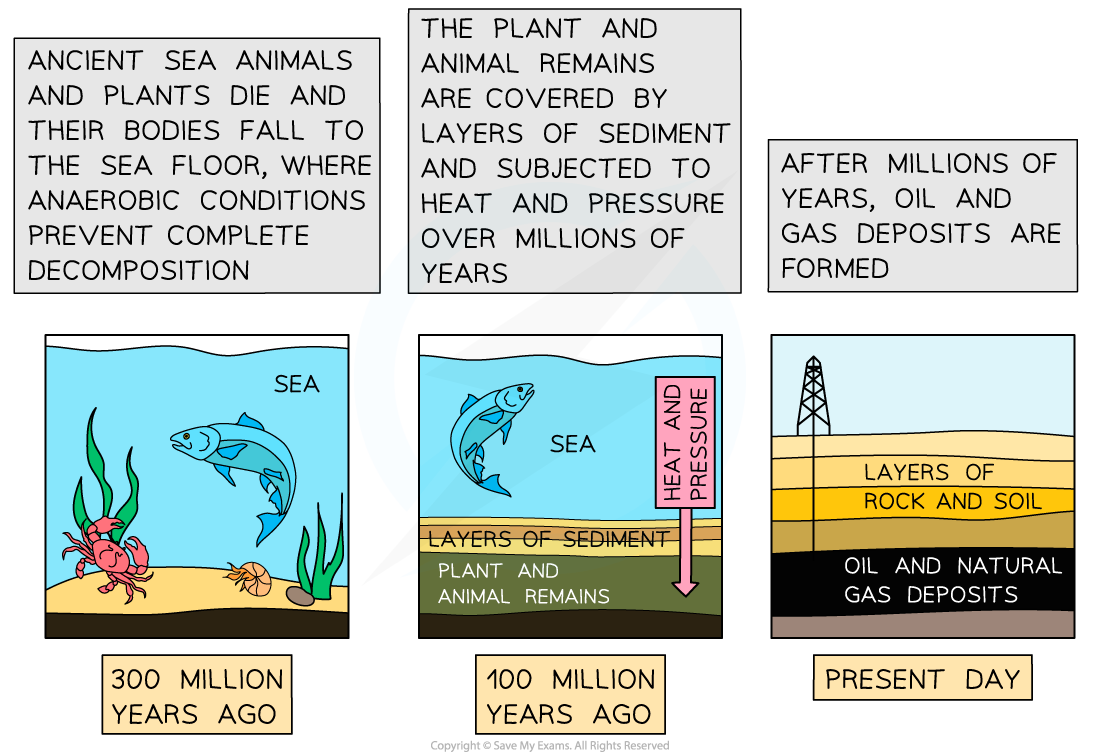
Formation of oil and gas from the bodies of aquatic organisms
- When fossil fuels are burned (the process is known as?combustion), the carbon combines with oxygen and?carbon dioxide is released?into the atmosphere
- Increased use of fossil fuels?is contributing to an increase in the carbon dioxide content of the atmosphere
Limestone Formation
- Many?marine?(sea-living)?organisms?extract?carbon?from their surroundings in order to produce?calcium carbonate, from which they build certain body parts. For example:
- The shells of?molluscs?(e.g. mussels and clams)
- The hard bodies (exoskeletons) of?corals
- When these organisms die, the soft parts of their bodies are broken down by decomposers, but their?calcium carbonate outer shells remain?and fall to the seafloor
- The?layers of sediment?that form on the seafloor are rich in the calcium carbonate shells of marine organisms, and as the layers are?compacted?with their own weight and that of the sea above them, they harden, and?limestone?is formed
- The carbon in the hard shells of these marine organisms is?locked up?in limestone rocks e.g. chalk
- Ocean acidification can cause the calcium carbonate shells of marine organisms to dissolve, releasing this carbon back into the surrounding water
轉載自savemyexams
以上就是關于【IB DP Biology: HL復習筆記4.2.4 Carbon Cycle: Organic Matter】的解答,如需了解學校/賽事/課程動態,可至翰林教育官網獲取更多信息。
往期文章閱讀推薦:
MIT官方發布【2026年夏季推薦閱讀書單】!橫跨科學/人文/經濟...


翰林AMC8視頻課重磅上線!

國際競賽真題資源免費領取






