IB DP Biology: HL復習筆記2.7.1 Cellular Respiration

Cellular Respiration Defined
- Cell respiration is the controlled release of energy from organic compounds to produce ATP
- Respiration is a?series of chemical reactions?that happens in?every cell
- Its purpose is to?release energy?in usable forms from the chemical energy stored in food e.g. glucose
- Respiration is a?catabolic?process
- Glucose?is the main respiratory fuel used in cells
- Lipids?and?proteins?can also be used
Organic?food substances contain?a lot of chemical energy
- This?energy cannot be released in one, uncontrolled step?in cells, which would cause cell damage and tissue death
- Enzymes?control the release of energy?through a series of chemical reactions called a?pathway
- This ends in the production of?ATP?(adenosine triphosphate)
- To make ATP, a?phosphate group?is linked to adenosine diphosphate (ADP)
- This process?requires energy?which comes from the breakdown of organic molecules
The energy that is released is used for
- Fuelling?anabolic?processes
- Muscle contraction
- Fuelling?active transport
- Moving molecules around the cell
- Generating heat?to maintain body temperature in warm-blooded animals
Exam Tip
Respiration is?often confused with breathing,?but remember, respiration is a chemical process, breathing is a method of moving air in and out of the body
ATP
- ATP is a?source of energy?for cellular processes
- The energy can be released?immediately, exactly when it is required
- All organisms require a?constant supply of energy?to maintain their cells and stay alive
- This energy is required:
- In?anabolic?reactions – synthesizing larger molecules from smaller molecules
- To?move molecules?across the cell membrane (active transport)
- To move substances and organelles within the cell
- In animals, energy is required:
- For?muscle contraction?– to coordinate movement at the whole-organism level
- In the?conduction of nerve impulses, as well as many other cellular processes
In all known forms of life, ATP from respiration is used to transfer energy in all energy-requiring processes?in cells
- ATP is converted to?ADP?and?phosphate?when releasing its energy
- ADP and phosphate can then be?re-converted to ATP?during respiration
Organisms require a constant supply of ATP?because much of the energy is dissipated (lost to the surroundings) as?heat
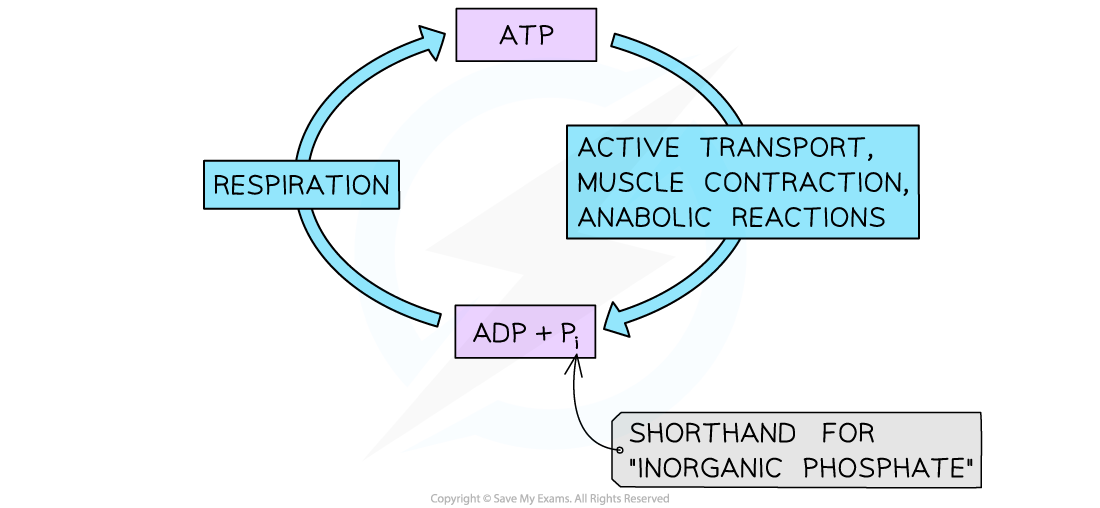
The constant cycling of ATP and ADP+Pi?within a cell
轉載自savemyexams
以上就是關于【IB DP Biology: HL復習筆記2.7.1 Cellular Respiration】的解答,如需了解學校/賽事/課程動態,可至翰林教育官網獲取更多信息。
往期文章閱讀推薦:
MIT官方發布【2026年夏季推薦閱讀書單】!橫跨科學/人文/經濟...


翰林AMC8視頻課重磅上線!

國際競賽真題資源免費領取






