IB DP Biology: HL復習筆記2.2.2 Fatty Acids

Fatty Acids: Types
- Triglycerides are a form of lipid, made up of one molecule of?glycerol?with three?fatty acids?attached to it
- These fatty acids have?long hydrocarbon ‘tails’
- Fatty acids occur in?two?forms:
- Saturated?fatty acids
-
- Unsaturated fatty acids can be?monounsaturated?or?polyunsaturatedUnsaturated fatty acids
The difference between these fatty acid types is found in their hydrocarbon tails
Saturated fatty acids
- In saturated fatty acids, the bonds between the carbon atoms in the hydrocarbon tail are?all single bonds
- The fatty acid is said to be?‘saturated’ with hydrogen
- This means that each carbon atom in the hydrocarbon tail (except for the final carbon atom) is bonded to?two hydrogen atoms
Saturated fatty acids can be synthesised industrially?by?hydrogenation?(reaction with hydrogen gas) of unsaturated fatty acids
- All the carbon-to-carbon bonds are?single bonds in saturated fatty acids
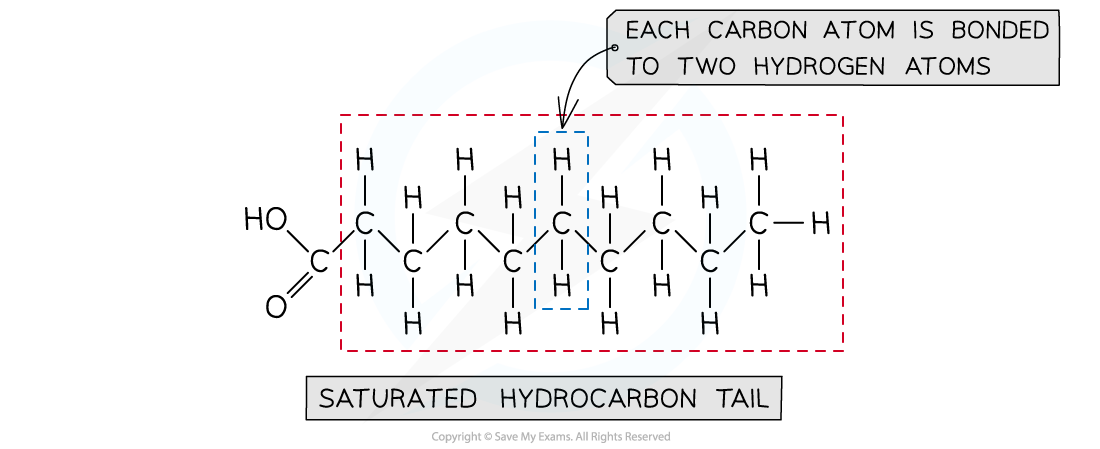
An example of a saturated fatty acid
Unsaturated fatty acids
- In unsaturated fatty acids, the bonds between the carbon atoms in the hydrocarbon tail are?not all single bonds
- There is?at least one carbon-carbon double bond; a fatty acid with one C=C double bond is known as?monounsaturated?fatty acidIn some unsaturated fatty acids, there are many?carbon-carbon double bonds; these are known as?polyunsaturated?fatty acids
- These double bonds can cause the hydrocarbon tail of unsaturated fatty acids to?kink?(bend slightly), meaning they are?not as straight as saturated fatty acids
The fatty acid is said to be ‘unsaturated’?because the hydrocarbon tail?does not contain the maximum number of hydrogen atoms?possible
- This is because each carbon atom in a carbon-carbon double bond?can only bond to one hydrogen atom (instead of two)
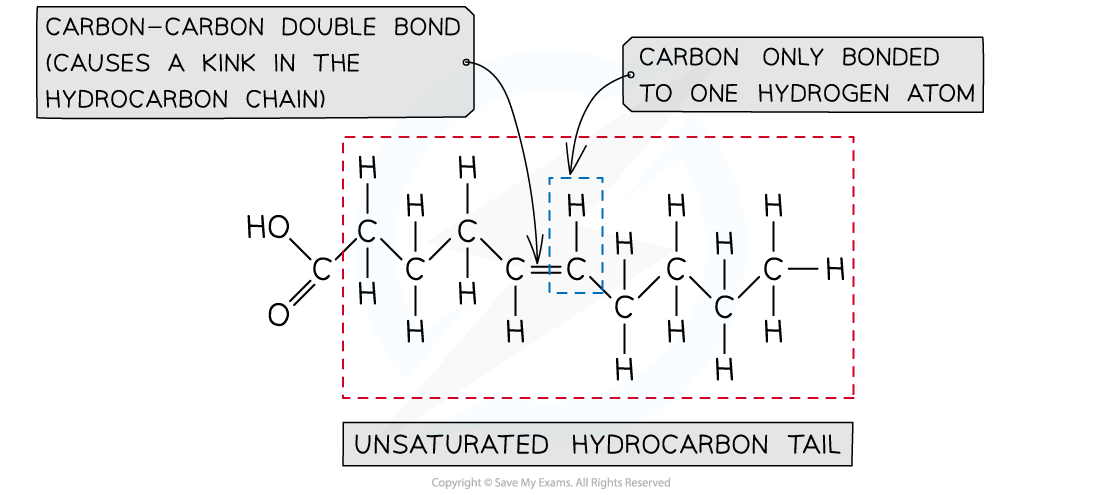
An example of a monounsaturated fatty acid
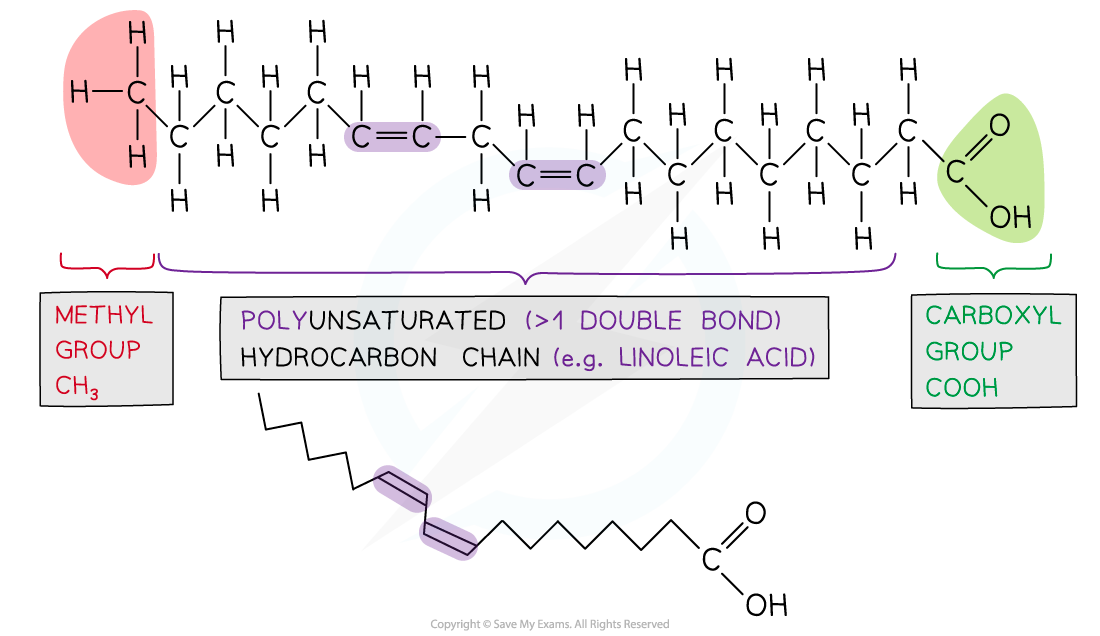
An example of a polyunsaturated fatty acid
Exam Tip
You don't need to know the names of various fatty acids, but you should be able to recognise from a diagram whether a fatty acid is saturated, monounsaturated or polyunsaturated (look for any carbon-carbon double bonds)!
Unsaturated Fatty Acids
The different isomers of unsaturated fatty acids
- A single C-C bond in a hydrocarbon chain is able to?rotate along its axis so?that rotation of one part of the molecule in relation to others is possible
- The rotation may cause?conformational changes?in molecules but they all remain?identical
- However, when there is a?C=C double bond?in a hydrocarbon chain,?no rotation?is possible
- This causes?isomers?of fatty acids to be formed, each with different properties
- The isomers are labelled?cis?and?trans?isomers
Cis-isomers
- At a C=C double bond, the attached hydrogen atoms are on the?same side?of the hydrocarbon chain as each other
- This causes a?kink in the fatty acid chain?which means the fatty acid chains are less tightly packed together,?lowering their melting point?(less kinetic energy is needed to break them apart)
- Triglycerides that contain cis-unsaturated fatty acids are?liquid (oils) at room temperature
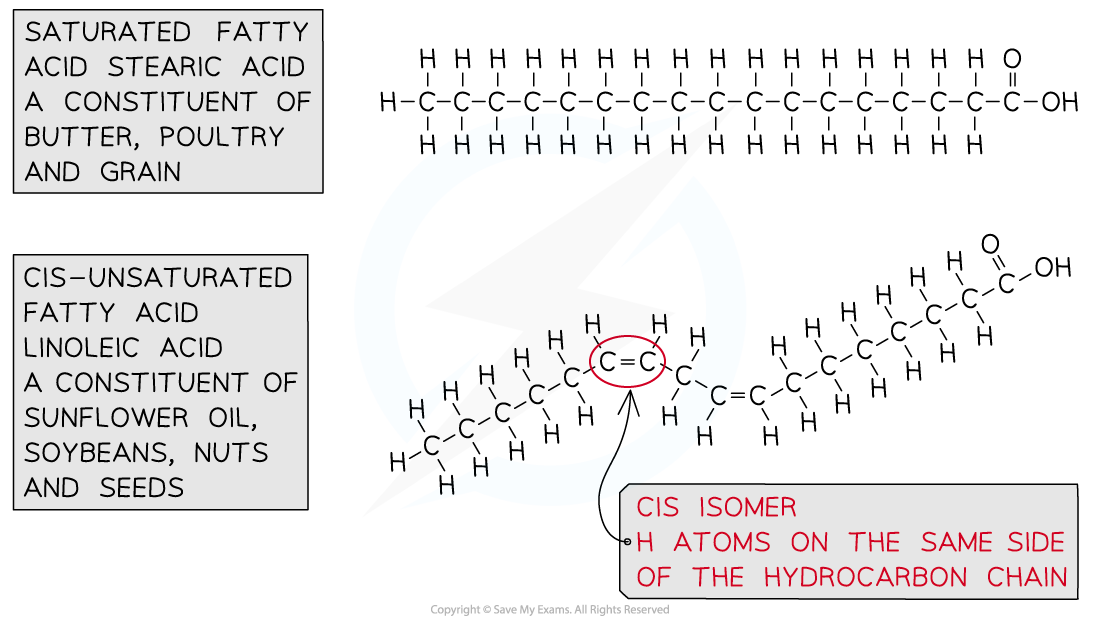
The Structural Differences Between a Saturated and a Cis-Unsaturated Fatty Acid
Trans-isomers
- At a C=C double bond, the attached hydrogen atoms are on the?opposite sides?of the hydrocarbon chain to each other
- The lack of bend in the hydrocarbon chain allows them to pack more closely together meaning they have a?higher melting point?(this property makes them more attractive to food manufacturers)
- Triglycerides that contain trans-saturated fatty acids are?solid are room temperature
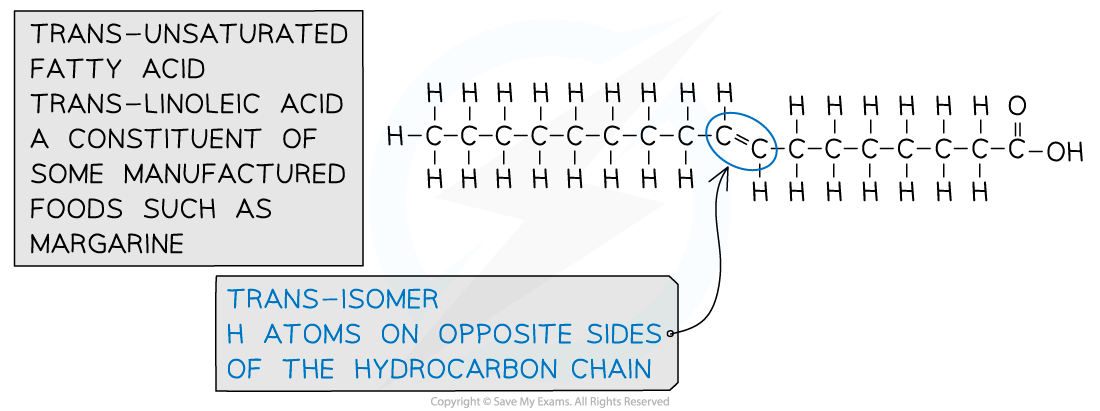
The Structure of a Trans-Unsaturated Fatty Acid
Fatty Acids: Health Risks
The use of trans-fatty acids in the food industry
- Trans-fatty acids occur in small quantities in natural products such as?dairy?and?red meat
- Artificial trans-fats (which contain trans-fatty acids) are made industrially by the?hydrogenation?of liquid vegetable oils
- Trans-fats are?favoured by food manufacturers?for commercial reasons
- They are more?solid at room temperature
- They create?more stable emulsions?in shortening agents
- Food products with trans-fats appear (in their retail packaging)?drier?and?less 'greasy'?to consumers
- Alleged?taste?benefits (though this is subjective)
- They can be?reused?more times eg. in large-scale deep-fat fryers
- Many countries have?legislated to restrict the use of trans-fats?in the foodservice industry
Many foods that contains trans-fats (often labelled as 'partially hydrogenated vegetable oils') are sold as processed products in supermarkets
- Biscuits/cookies
- Cakes
- Doughnuts
- Pie crusts
- Crisps
- Pizza bases
- Certain kinds of margarine and spreads
Trans-fatty acids have associated health risks
- The two types of fat that lead to health problems are namely?saturated fats?and?trans-fats
- Doctors recommend limiting your intake of these types of fats
Trans-fats alter the balance of various types of cholesterol
- They?increase low-density lipoprotein (LDL)?levels in circulation (so-called 'bad' cholesterol)
- They?decrease high-density lipoprotein (HDL)?levels in circulation (so-called 'good' cholesterol)
LDLs are known to increase the risk of coronary heart disease, blood clotting and strokes
- Doctors recommend that the bulk of fats intake should come from?monounsaturated fats, which?reduce?LDL levels
- Omega-3 fats and oils are a well-publicised source of monounsaturated fats; these are found in fish, pulses and certain nuts
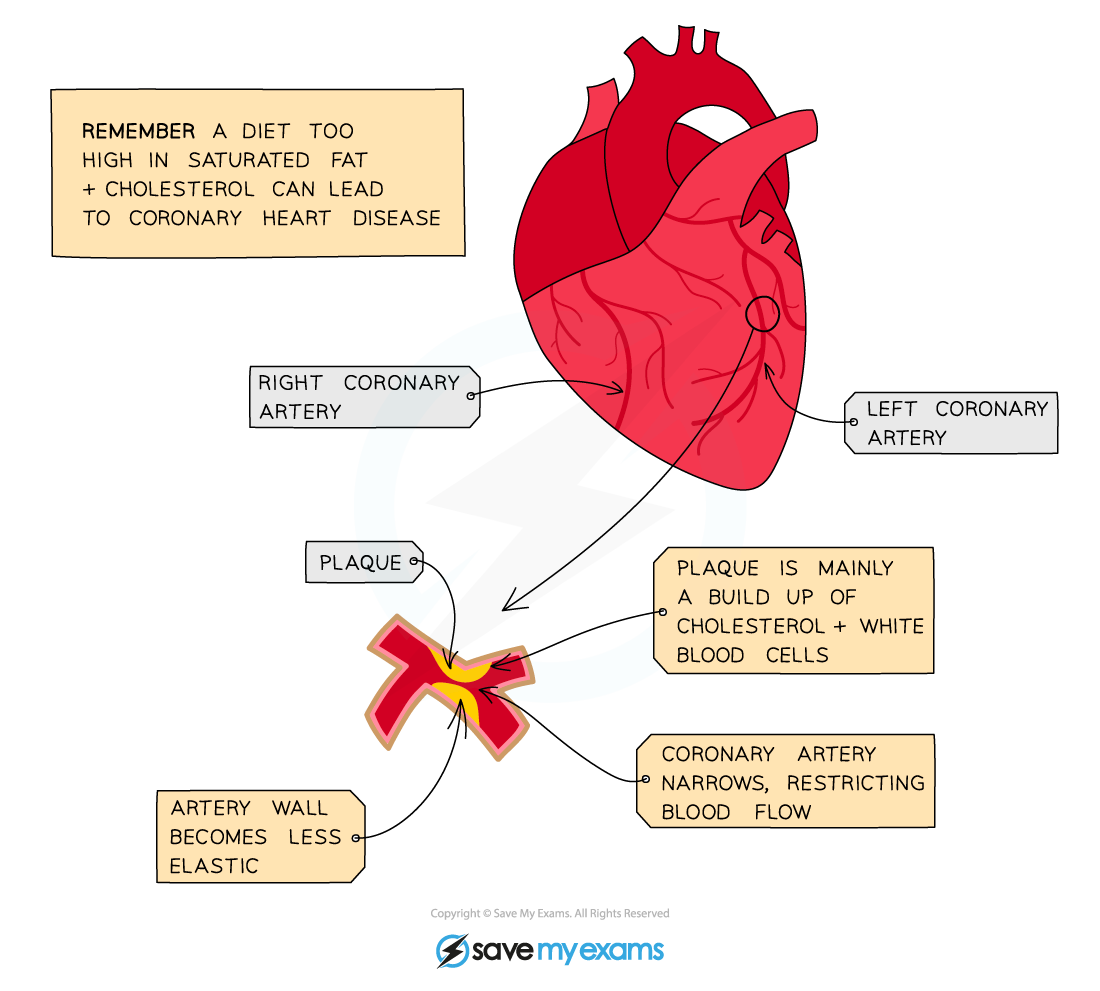 Excess consumption of trans-fatty acids and saturated fats can lead to the buildup of cholesterol and the blockage of coronary arteries, causing Coronary Heart Disease (CHD)
Evaluating claims
- Evidence for the claims surrounding the health risks associated with trans-fats often comes from 'cohort studies'
- Eg. Greenland Eskimos, whose diet is rich in oily fish and meat, have a very low incidence of heart disease
Other epidemiological studies?can establish correlations between diet and incidence of disease
- Whilst?it is rare to find a direct causal link?between fat intake and heart disease, the many claims about fats?suggest strongly?that trans-fats have an overall?detrimental effect?on health when consumed in high quantities
- Other conditions linked to trans-fats include
- Allergy
- Breast cancer
- Colonic cancer
- Cardiovascular diseases
- Premature birth
- Preeclampsia (a condition associated with pregnancy)
- Disorders of the nervous system
- Vision defects in infants
- Diabetes
- Obesity
Exam Tip
- It is important to remember that correlation does not always mean causation
- Correlation?is an association or relationship between variables
- Causation?occurs when one variable has an influence or is influenced by, another
- There is a clear distinction between correlation and causation: a correlation does not necessarily imply a causative relationship
轉載自savemyexams
以上就是關于【IB DP Biology: HL復習筆記2.2.2 Fatty Acids】的解答,如需了解學校/賽事/課程動態,可至翰林教育官網獲取更多信息。
往期文章閱讀推薦:
MIT官方發布【2026年夏季推薦閱讀書單】!橫跨科學/人文/經濟...


翰林AMC8視頻課重磅上線!

國際競賽真題資源免費領取






