IB DP Maths: AI HL復(fù)習(xí)筆記3.5.1 Voronoi Diagrams

Drawing Voronoi Diagrams
What are Voronoi Diagrams?
- A?Voronoi diagram?shows the region containing the set of all points which are?closer?to one given?site?than to any other?site?on the diagram
- A?site?is located at the coordinates of a specific place of interest on a Voronoi diagram
- It will be partitioned into a number of?regions
- These regions are often called?Voronoi cells?and will be?polygons
- There will be the same number of?regions?as?sites?on the diagram
- For example, if a city contains five parks a Voronoi diagram could be drawn for that city dividing it into five regions based on their closest park
- These regions are often called?Voronoi cells?and will be?polygons
- The?edges?of each region will be the?perpendicular bisector?of two of the sites
- The?edges?may also be called?boundaries
- The?vertices?of each region are the?intersections?of?three?of these perpendicular bisectors
- The perpendicular bisectors of three individual points will always intersect at the point that is?equidistant?from the three points
How are Voronoi diagrams drawn for three sites?
- You will?not?be expected to draw a Voronoi diagram from scratch, however you should understand how one is constructed
- First, the perpendicular bisector of the line segment joining each pair of sites will be constructed
- These should be constructed using dashed lines as only a part of each line will be needed for the final diagram
- The?points of intersection?of these perpendicular bisectors will create the?vertices
- Each perpendicular bisector should stop when it meets another perpendicular bisector
- Remove the part of the perpendicular bisector that is not in the region of the two sites
- No perpendicular bisector should cross over another
- This will form the?regions, or?cells
- First, the perpendicular bisector of the line segment joining each pair of sites will be constructed
How are Voronoi diagrams drawn for more than three sites?
- It is challenging to draw a Voronoi diagram from scratch if it has?more than three sites
- In this case it is easiest to draw the Voronoi diagram for three sites first and then add the next sites one by one following these steps
-
- STEP 1: The fourth site will be in one of the cells containing an existing site
-
-
- Draw the perpendicular bisector of the line segment between these two sites
-
-
- STEP 2: Stop this new line at the point where it meets an existing?boundary?in the Voronoi diagram
- STEP 3: There will now be an existing edge in the region of the new site
-
-
- This should be?shortened?to meet the new boundary
-
-
- STEP 4: The fourth site will now be in the same cell as a different existing site
-
-
- Draw the perpendicular bisector of the line segment between these two sites
- This is the step you will most likely carry out in an exam
-
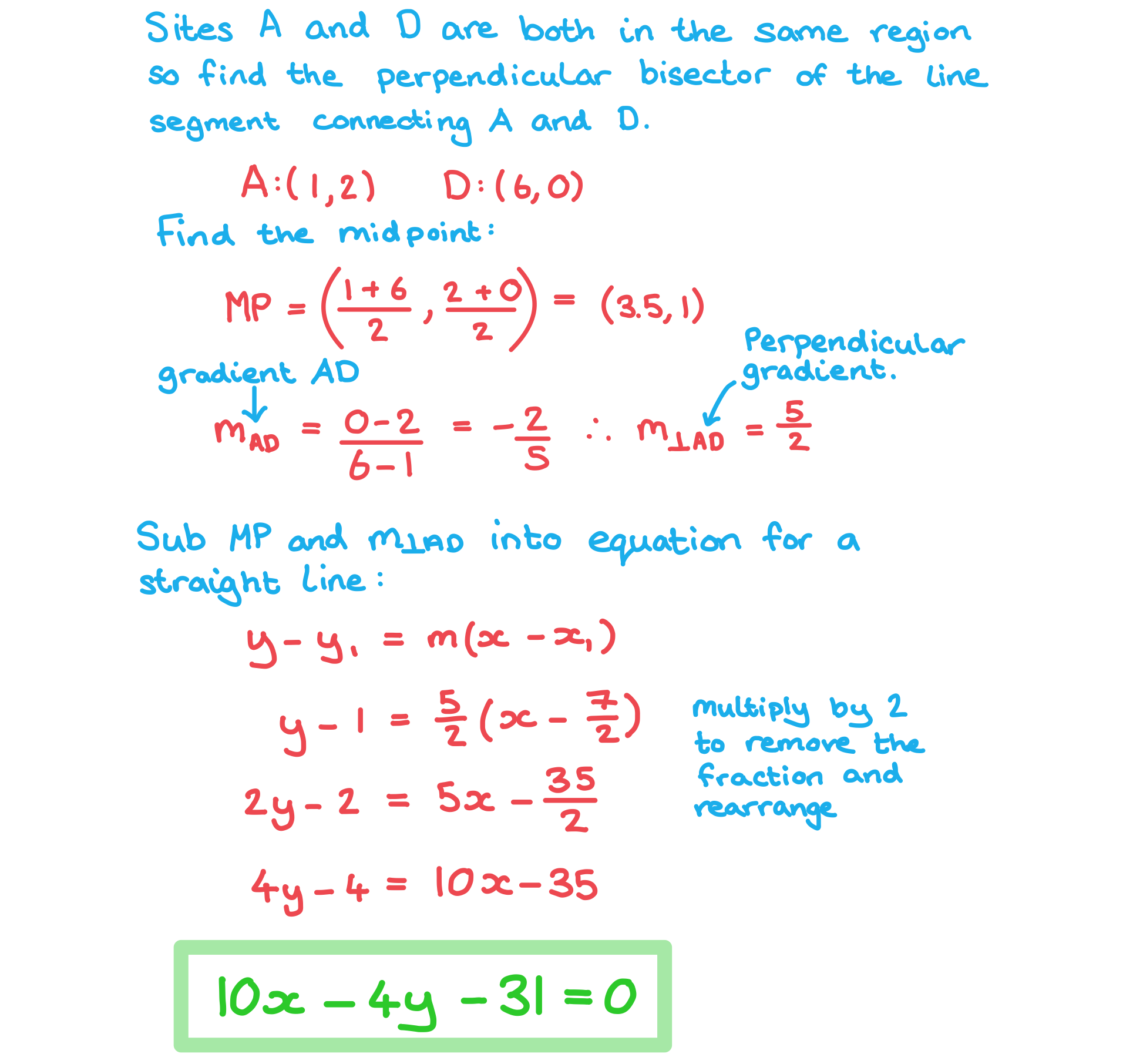
- You may be asked to find the?equation of a missing edge
- This will mean finding the equation of the?perpendicular bisector?between the?two sites?that are both within?one region
- You may be asked to add the?location of a missing site?to the Voronoi diagram
- This will mean using the given?edge?of one or two of the regions and finding the second site that would make this edge a perpendicular bisector
- Draw a perpendicular line from the site to the edge
- Check the distance of this line and then continue it on the other site of the edge for the same distance
- This will be the location of your new site
- You may need to find the gradients of the edges you have and then use the negative reciprocal to find the gradient of the perpendicular bisector of the current and new site
- This will mean using the given?edge?of one or two of the regions and finding the second site that would make this edge a perpendicular bisector
Exam Tip
- Make sure that you have a straight edge and an eraser with you in the exam so that any perpendicular bisectors that you draw are clear and any mistakes that are made can be erased
- If you are asked to adjust a given Voronoi diagram and a perpendicular bisector that needs to be removed or shortened, you can put a series of little lines along it to indicate that it is crossed out
Worked Example
The Voronoi diagram below shows sites A, B, C and D.
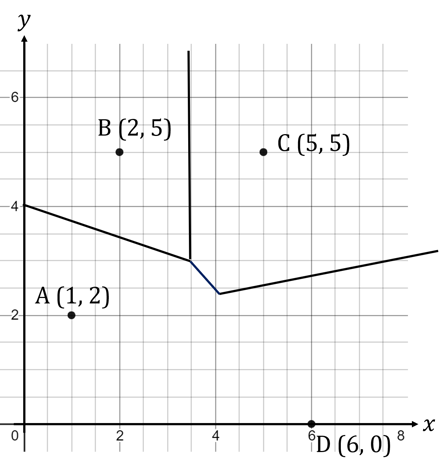
a)Explain how you know that the Voronoi diagram is incomplete.


Interpreting Voronoi Diagrams
What is a Voronoi diagram used for?
- Voronoi diagrams are often used in land management to work out where the best location would be according to where sites are already situated
- They can show where to put something to make sure that it is
- Closest to a particular site
- Closer to one site than another
- Equidistant from two or three specific sites
- As far as possible from any other site
What do I need to know about Voronoi diagrams?
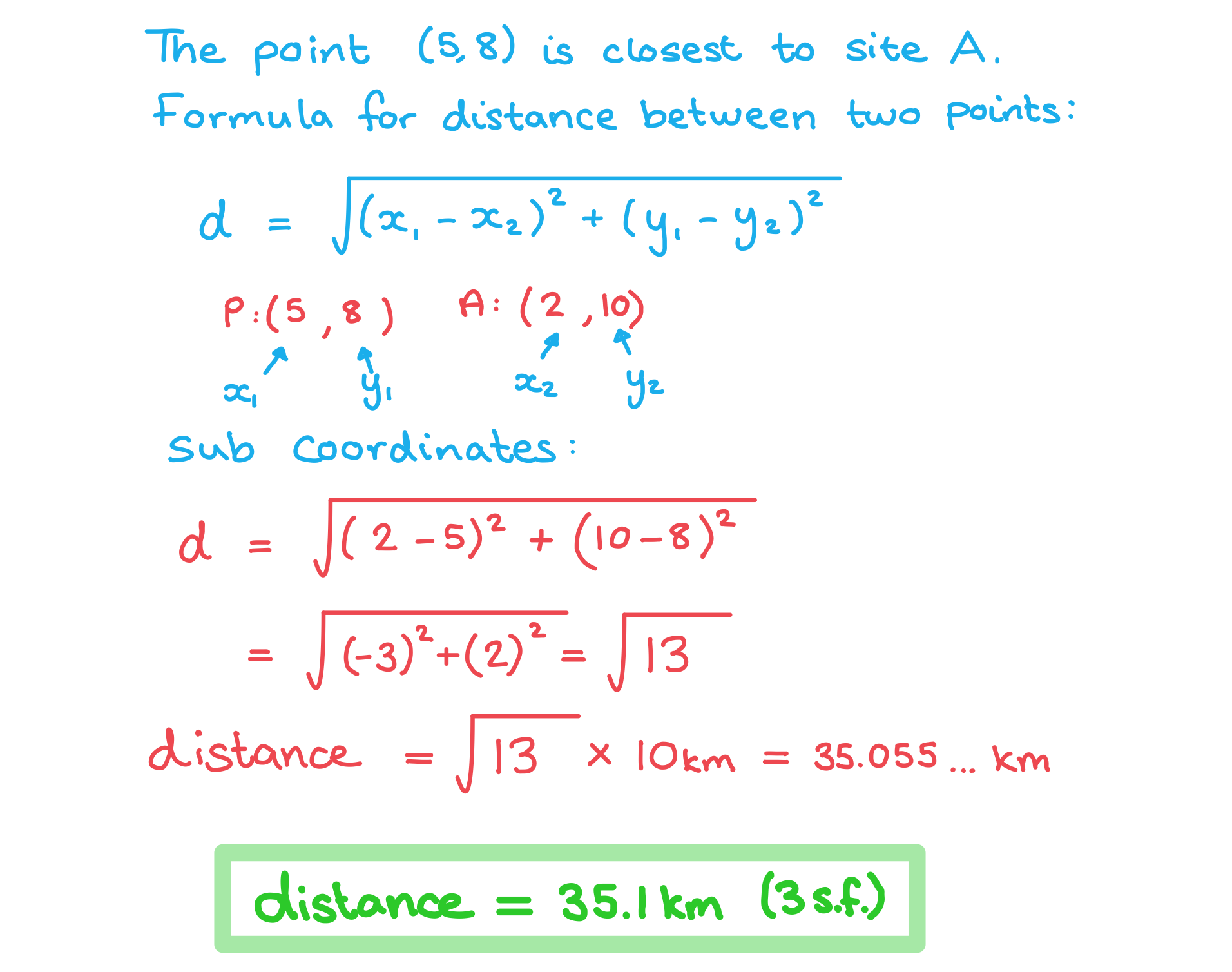
- You may be asked to find the shortest distance from a point to its closest site
- Use Pythagoras’ Theorem to find the distance between the given coordinate and the site in the same region as it
- If the coordinate is on an edge then there will be two sites?equidistant?from it
- You may be asked to find the point which is furthest from any of the sites
- This will be one of the vertices
- To choose which vertex look at which is the centre of the?largest empty circle
- You may be asked to estimate the success of a new site
- This is done by looking at the data for the?nearest site
- The prediction for the new site would be assumed to be the same
- This is called?nearest neighbour interpolation
Worked Example
The Voronoi diagram below shows the four sites A, B, C and D with coordinates (2, 10), (14, 14), (14, 4), and (6, 2) respectively.? 1 unit represents 10 km.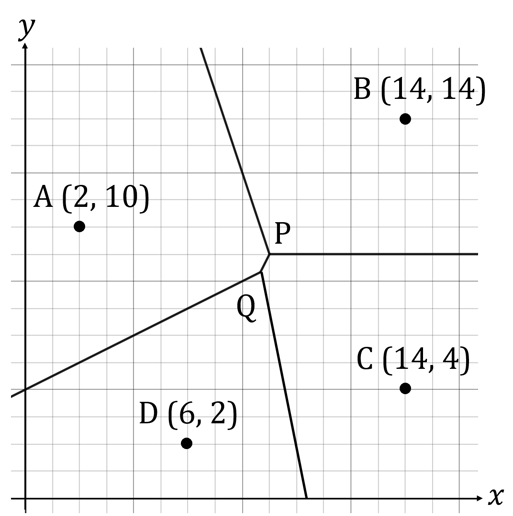
i)State which site a new business opening at the coordinate (5, 8) should look at to predict future sales.
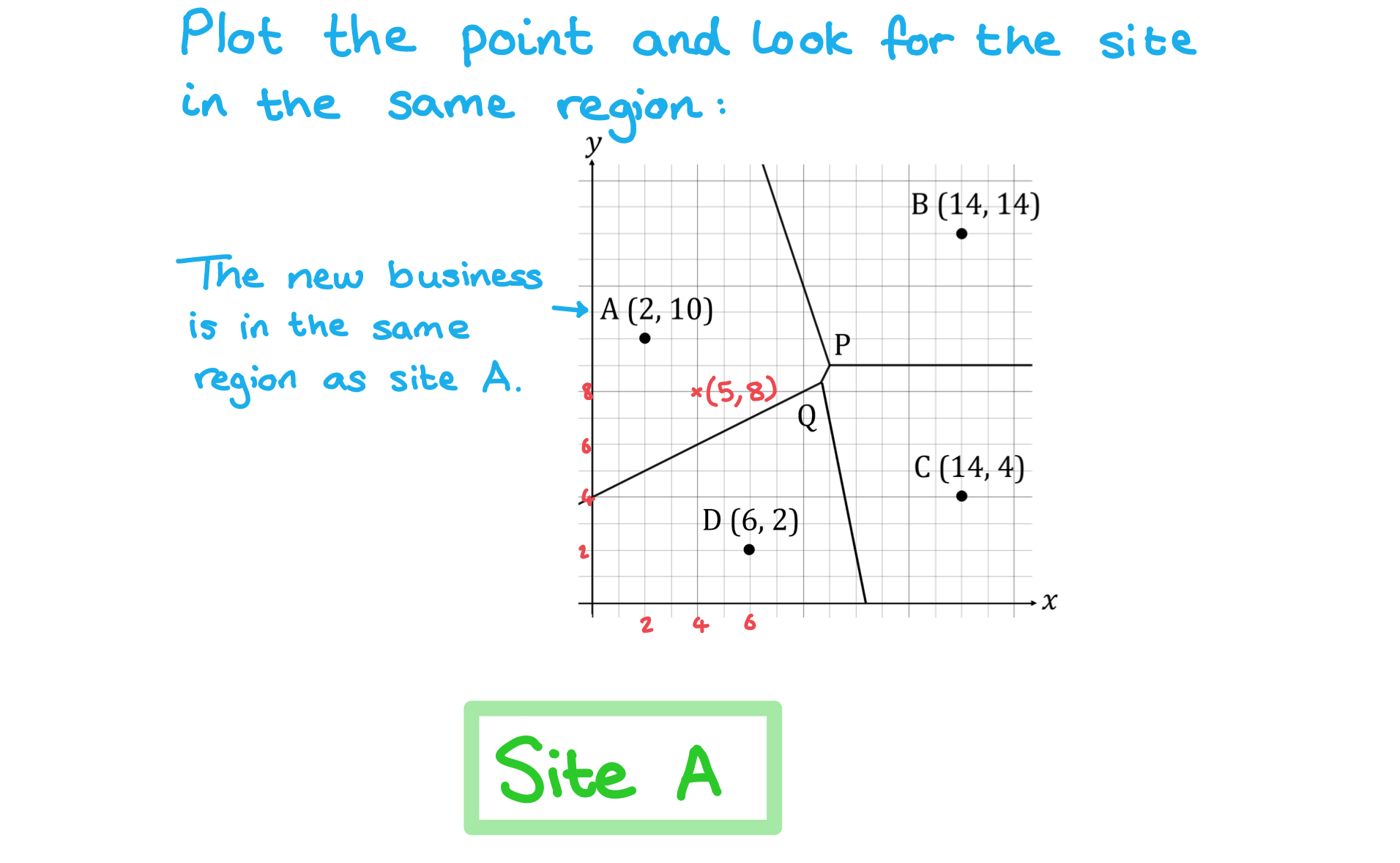
ii)Find the shortest distance from the point (5, 8) to its nearest site.
轉(zhuǎn)載自savemyexams
以上就是關(guān)于【IB DP Maths: AI HL復(fù)習(xí)筆記3.5.1 Voronoi Diagrams】的解答,如需了解學(xué)校/賽事/課程動(dòng)態(tài),可至翰林教育官網(wǎng)獲取更多信息。
往期文章閱讀推薦:
斯坦福大學(xué)官方推薦書單!名校學(xué)霸們暑假都在讀什么?
MIT官方發(fā)布【2026年夏季推薦閱讀書單】!橫跨科學(xué)/人文/經(jīng)濟(jì)...


翰林AMC8視頻課重磅上線!

國(guó)際競(jìng)賽真題資源免費(fèi)領(lǐng)取






