IB DP Maths: AA SL復(fù)習(xí)筆記4.1.1 Sampling & Data Collection

Types of Data
What are the different types of data?
- ?Qualitative?data is data that is usually given in words not numbers to?describe?something
- For example: the colour of a teacher's car
- Quantitative?data is data that is given using numbers which?counts or measures?something
- For example: the number of pets that a student has
- Discrete?data is quantitative data that needs to be?counted
- Discrete data can only take?specific values?from a set of (usually finite) values
- For example: the number of times a coin is flipped until a ‘tails’ is obtained
- Continuous?data is quantitative data that needs to be?measured
- Continuous data can take?any value?within a range of infinite values
- For example: the height of a student
- Age?can be?discrete or continuous?depending on the context or how it is defined
- If you mean how many years old a person is then this is discrete
- If you mean how long a person has been alive then this is continuous
What is the difference between a population and a sample??
- The?population?refers to the?whole set?of things which you are interested in
- For example: if a vet wanted to know how long a typical French bulldog slept for in a day then the population would be all the French bulldogs in the world
- A?sample?refers to a?subset of the population?which is used to collect data from
- For example: the vet might take a sample of French bulldogs from different cities and record how long they sleep in a day
- A?sampling frame?is a?list?of all members of the?population
- For example: a list of employees’ names within a company
- Using a?sample instead of a population:
- Is quicker and cheaper
- Leads to less data needing to be analysed
- Might not fully represent the population
- Might introduce bias
Sampling Techniques
What is a random sample and a biased sample??
- A?random sample?is where every member of the population has an equal chance of being included in the sample
- A?biased sample?is where the sample is?not random
What sampling techniques do I need to know??
Simple random sampling?
- Simple random sampling?is where every group of members from the population has an?equal probability?of being selected for the sample
- To carry this out you would...
- uniquely number every member of a population
- randomly select?n?different numbers using a random number generator or a form of lottery (where numbers are selected randomly)
- Effectiveness:
- Useful when you have a small population or want a small sample (such as children in a class)
- It can be time-consuming if the sample or population is large
- This can not be used if it is not possible to number or list all the members of the population (such as fish in a lake)
Systematic sampling
- Systematic sampling?is where a sample is formed by choosing members of a population at regular intervals using a list
- To carry this out you would...
 choose a random starting point between 1 and?k
- select every?kth member after the first one
- Effectiveness:
- Useful when there is a natural order (such as a list of names or a conveyor belt of items)
- Quick and easy to use
- This can not be used if it is not possible to number or list all the members of the population (such as penguins in Antarctica)
Stratified sampling?
- Stratified sampling?is where the population is divided into disjoint groups (called strata) and then a random sample is taken from each group (stratum)
- The proportion of a stratum that is sampled is equal to the proportion of the population that belong to that stratum
- To carry this out you would...
- Calculate the number of members sampled from each stratum
 Take a random sample from each stratum
- Effectiveness:
- Useful when there are very different groups of members within a population
- The sample will be representative of the population structure
- The members selected from each stratum are chosen randomly
- This can not be used if the population can not be split into groups or if the groups overlap
Quota sampling
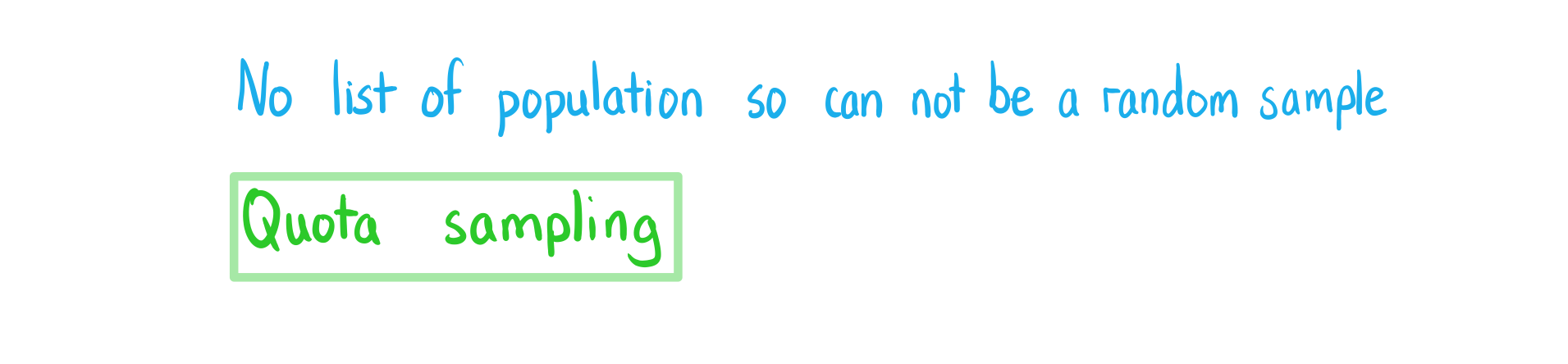
- Quota sampling?is where the population is split into groups (like stratified sampling) and members of the population are selected until each quota is filled
- To carry this out you would...
- Calculate how many people you need from each group
- Select members from each group until that quota is filled
- The members do not have to be selected randomly
- Effectiveness:
- Useful when collecting data by asking people who walk past you in a public place or when a sampling frame is not available
- This can introduce bias as some members of the population might choose not to be included in the sample
Convenience sampling
- Convenience sampling?is where a sample is formed using available members of the population who fit the criteria
- To carry this out you would...
- Select members that are easiest to reach
- Effectiveness:
- Useful when a list of the population is not possible
- This is unlikely to be representative of the population structure
- This is likely to produce biased results
What are the main criticisms of sampling techniques??
- Most sampling techniques can be improved by taking a larger sample
- Sampling can introduce bias - so you want to minimise the bias within a sample
- To minimise bias the sample should be as close to random as possible
- A sample only gives information about those members
- Different samples may lead to different conclusions about the population
Worked Example
Mike is a biologist studying mice in an open enclosure. He has access to approximately 540 field mice and 260 harvest mice. Mike wants to sample 10 mice and he wants the proportions of the two types of mice in his sample to reflect their respective proportions of the population.
a)? ? ? ? Calculate the number of field mice and harvest mice that Mike should include in his sample.
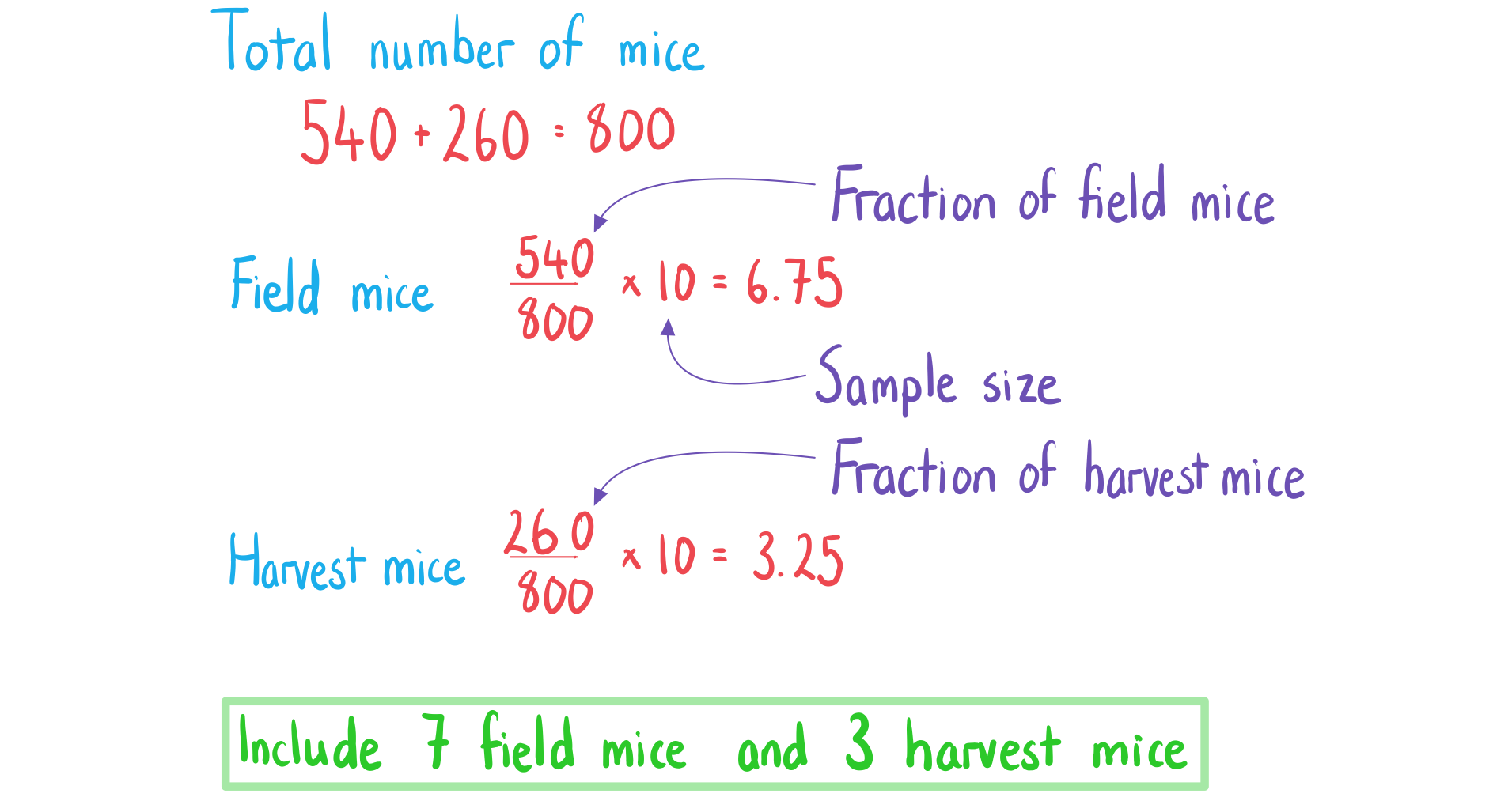
b)? ? ? ? Given that Mike does not have a list of all mice in the enclosure, state the name of this sampling method.
c)? ? ? ? Suggest one way in which Mike could improve his sampling method.

Reliability of Data
How can I decide if data is reliable?
- Data from a sample is reliable if similar results would be obtained from a different sample from the same population
- The sample should be?representative?of the population
- The sample should be?big enough
- Sampling a small proportion of a population is unlikely to be reliable
What can cause data to be unreliable?
- If the sample is?biased
- It is?not random
- If?errors?are made when collecting data
- Numbers could be recorded incorrectly, duplicated or missed out
- If the person collecting the data?favours some members?over others
- They might seek out members who will lead to a desired outcome
- They might exclude members if they would cause the sample to oppose the desired outcome
- If a significant proportion of?data is missing
- Some data may be unavailable
- Some members might decide not to be part of the sample
- This will mean the results are not necessarily representative of the population
轉(zhuǎn)載自savemyexams
以上就是關(guān)于【IB DP Maths: AA SL復(fù)習(xí)筆記4.1.1 Sampling & Data Collection】的解答,如需了解學(xué)校/賽事/課程動(dòng)態(tài),可至翰林教育官網(wǎng)獲取更多信息。
往期文章閱讀推薦:
斯坦福大學(xué)官方推薦書單!名校學(xué)霸們暑假都在讀什么?
MIT官方發(fā)布【2026年夏季推薦閱讀書單】!橫跨科學(xué)/人文/經(jīng)濟(jì)...


翰林AMC8視頻課重磅上線!

國(guó)際競(jìng)賽真題資源免費(fèi)領(lǐng)取






