AQA A Level Physics復(fù)習(xí)筆記5.2.2 Resistance in a Thermistor

Temperature & Resistance
- All solids are made up of vibrating atoms
- The higher the temperature, the faster these atoms vibrate
- Electric current is the flow of free electrons in a material
- The electrons collide with the vibrating atoms which impede their flow, hence the current?decreases
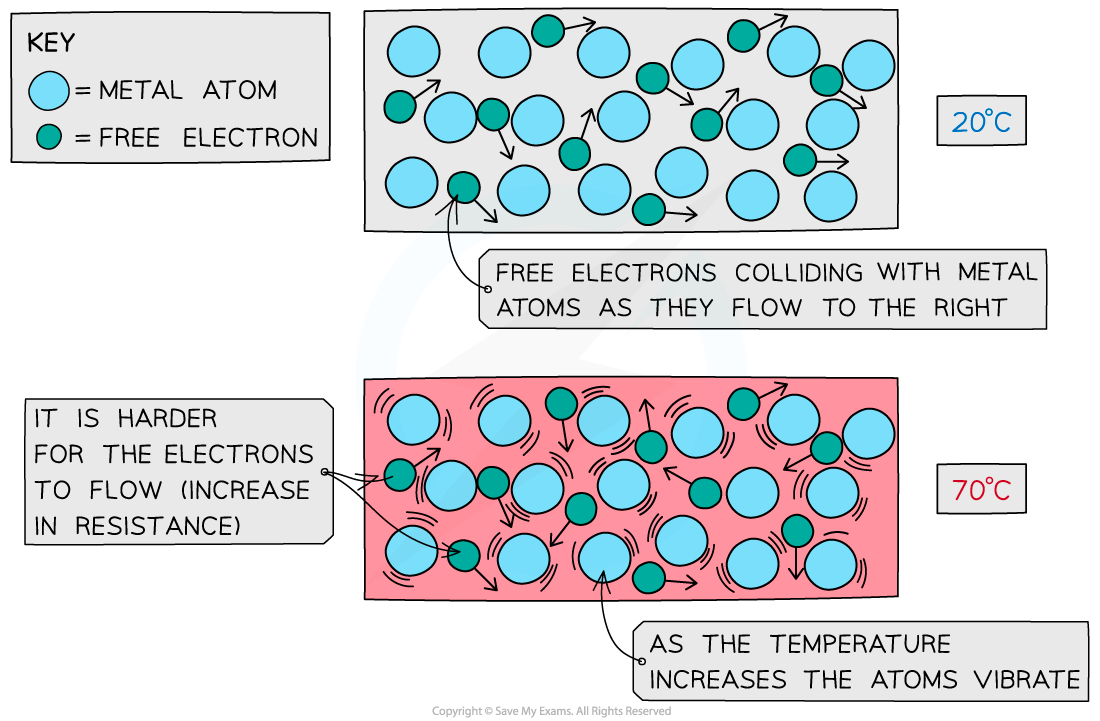
Metal atoms and free electrons at low and high temperatures
- So, if the current decreases, then the resistance will increase (from?V?=?IR)
- Therefore, for a metallic conductor which obeys Ohm's law:
- An?increase?in temperature causes an?increase?in resistance
- A?decrease?in temperature causes a?decrease?in resistance
- This is?not?the case for components such as a thermistor
- For a thermistor, an?increase?in temperature causes a?decrease?in resistance
Applications of a Thermistor
- A thermistor is a non-ohmic conductor and sensory resistor whose resistance varies with temperature
- Most thermistors are negative temperature coefficient (ntc) components.
- This means that if the temperature?increases,?the resistance of the thermistor?decreases?(and vice versa)
- The temperature-resistance graph for a thermistor is shown below
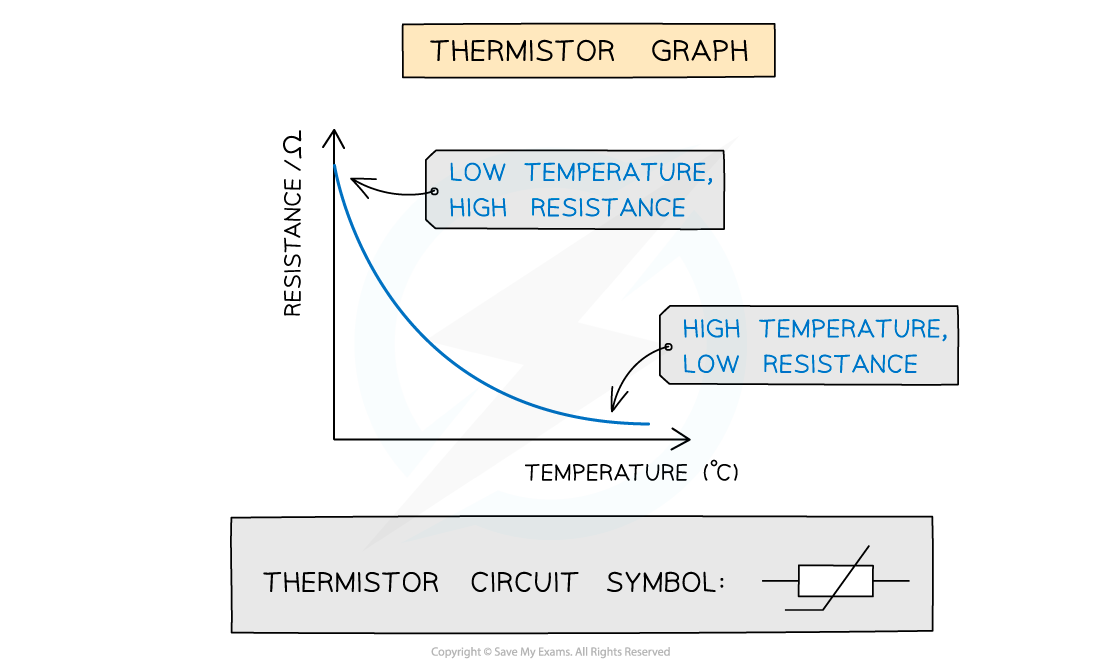
Graph of temperature against resistance for a thermistor
- Thermistors are temperature sensors and are used in circuits in ovens, fire alarms and digital thermometers
- As the thermistor gets?hotter, its resistance?decreases
- As the thermistor gets?cooler, its resistance?increases
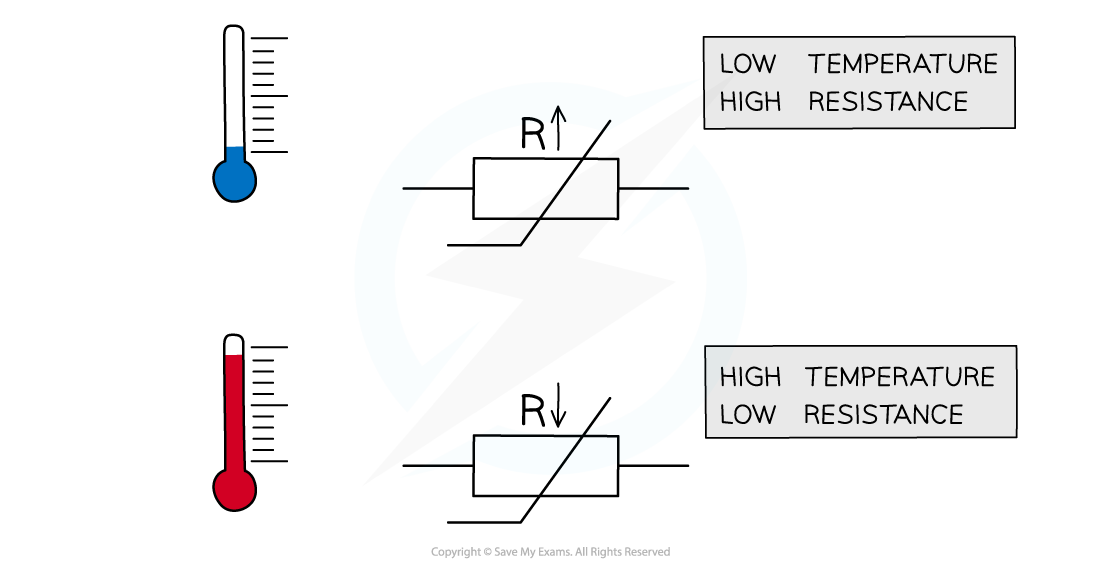
The resistance through a thermistor is dependent on the temperature of it
Worked Example
A thermistor is connected in series with a resistor?R?and a battery. The resistance of the thermistor is equal to the resistance of?R?at room temperature. When the temperature of the thermistor decreases, which statement is correct?
A.? ? ?The p.d across the thermistor increases
B.? ? ?The current in?R?increases
C.? ? ?The current through the thermistor decreases
D.? ? ?The p.d across?R?increases
? ? ?ANSWER: A
- The resistance of the thermistor increases as the temperature decreases
- Since the thermistor and resistor?R?are connected in series, the current?I?in both of them is the same
- Ohm’s law states that?V?=?IR
- Since the resistance of the thermistor increases, and?I?is the same, the potential difference?V?across it increases
- Therefore, statement?A?is correct
轉(zhuǎn)載自savemyexams
以上就是關(guān)于【AQA A Level Physics復(fù)習(xí)筆記5.2.2 Resistance in a Thermistor】的解答,如需了解學(xué)校/賽事/課程動態(tài),可至翰林教育官網(wǎng)獲取更多信息。
往期文章閱讀推薦:
斯坦福大學(xué)官方推薦書單!名校學(xué)霸們暑假都在讀什么?
MIT官方發(fā)布【2026年夏季推薦閱讀書單】!橫跨科學(xué)/人文/經(jīng)濟...


翰林AMC8視頻課重磅上線!

國際競賽真題資源免費領(lǐng)取






