AQA A Level Chemistry復(fù)習(xí)筆記7.5.4 Nucleophilic Addition–Elimination

Nucleophilic Addition–Elimination
- An important class of reactions that ammonia and amines undergo is?nucleophilic substitution?with acyl chlorides (or acid chlorides) and acid anhydrides
- These reactions are also called?nucleophilic addition-elimination?reactions
- Here is a reminder of the functional groups acyl chloride and acid anhydride:
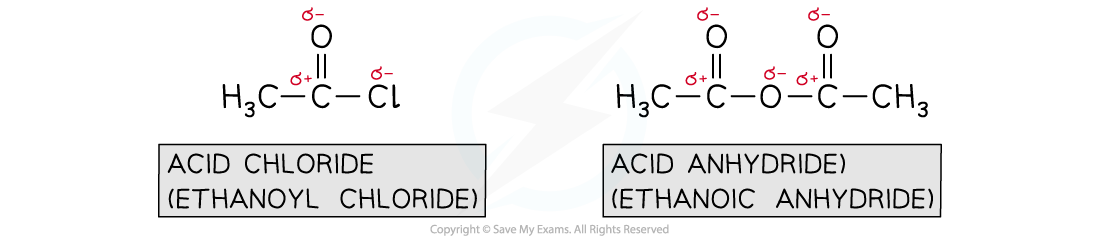
The acyl chloride and acid anhydride group showing the polarity of the functional group
- The delta positive carbon atom is the site of a the nucleophilic attack by the lone pair on the nitrogen in ammonia or the amine
- Chlorine is more electronegative than oxygen, so creates a stronger dipole along the C-Cl?bond making the carbon more susceptible to attack from nucleophiles which is which why acyl chlorides are more reactive than acid anhydrides
- The reaction produces HCl?as an elimination product (hence the name addition-elimination), but since both ammonia and amines are basic the HCl?reacts to form ammonium chloride or the amine salt respectively
- Hence, two moles of ammonia/amine are needed in the overall equation:
RCOCl??? + 2NH3???→??? RCONH2????+?? NH4Cl
and
RCOCl??? + 2R’NH2???→??? RCONHR’ ???+?? R’NH3Cl
Formation of amides: reaction mechanism
- The lone pair on the nitrogen atoms carry out an?initial?attack on the carbonyl carbon
- This is followed by the elimination of an HCl?molecule
- Both reactions of acyl chlorides with ammonia and amines are?vigorous?however there are also differences
- With?ammonia?- The product is a?non-substituted amide?and?white fumes?of NH4Cl are formed
- With?amines -?The product is a?substituted amide?and the HCl?formed reacts with the?unreacted amine?to form a?white organic ammonium salt
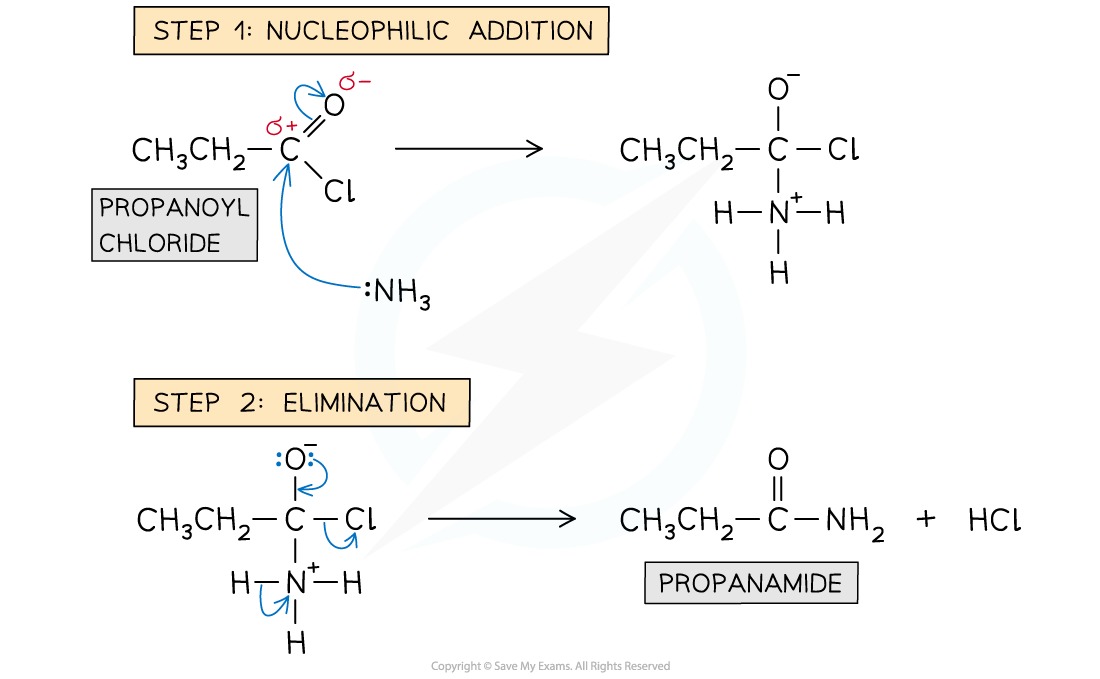
Reaction mechanism of the formation of amides from acyl chlorides with ammonia. The HCl then goes on to react with a molecule of NH3?to form NH4Cl
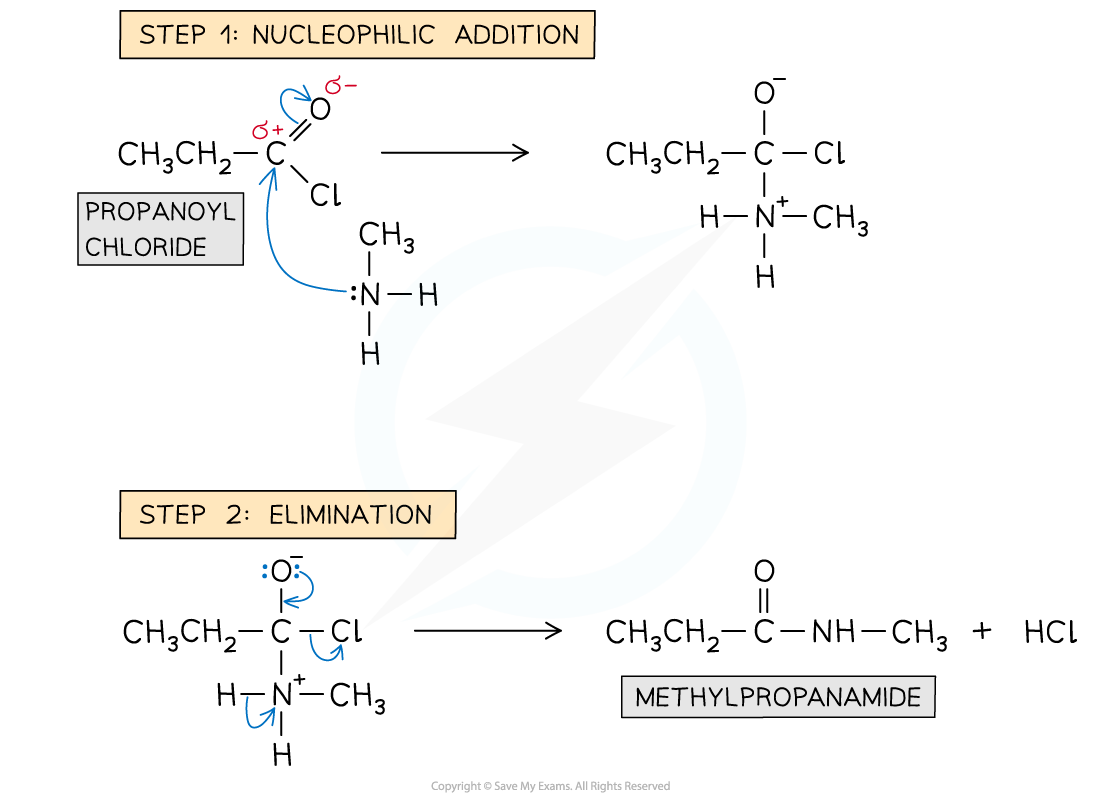
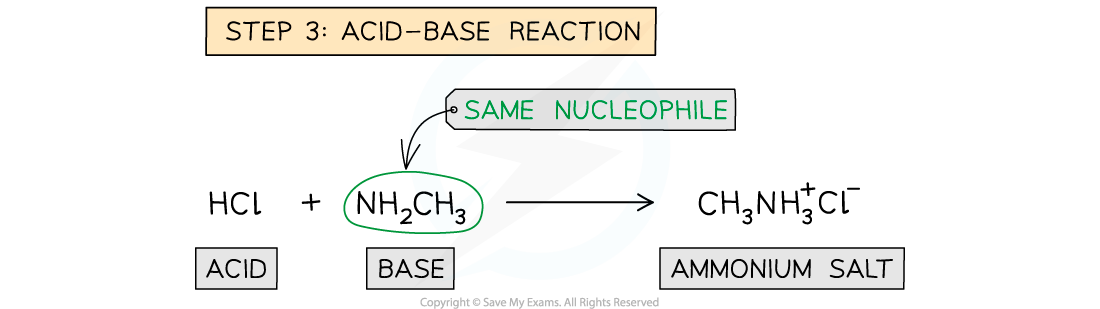
Reaction mechanism of the formation of amides from acyl chlorides with primary amines
Exam Tip
If you want to name substituted amines or amides you can use the prefix letter N, to show that the alkyl (or other group) is attached to the nitrogen, so in the last example calling it N-methylpropanmide avoids any ambiguity about the location of the methyl group.
轉(zhuǎn)載自savemyexams
以上就是關(guān)于【AQA A Level Chemistry復(fù)習(xí)筆記7.5.4 Nucleophilic Addition–Elimination】的解答,如需了解學(xué)校/賽事/課程動態(tài),可至翰林教育官網(wǎng)獲取更多信息。
往期文章閱讀推薦:
斯坦福大學(xué)官方推薦書單!名校學(xué)霸們暑假都在讀什么?
MIT官方發(fā)布【2026年夏季推薦閱讀書單】!橫跨科學(xué)/人文/經(jīng)濟...


翰林AMC8視頻課重磅上線!

國際競賽真題資源免費領(lǐng)取






