AQA A Level Chemistry復習筆記6.3.2 Reactions with Bases

Reactions with Bases
- The differences in the the chemistry of +2 and +3 aqua ions can be seen in their reactions with bases
- The reactions of iron(II), iron(III), copper(II) and aluminium with bases is summarised below
The reactions?of metal-aqua ions with bases table
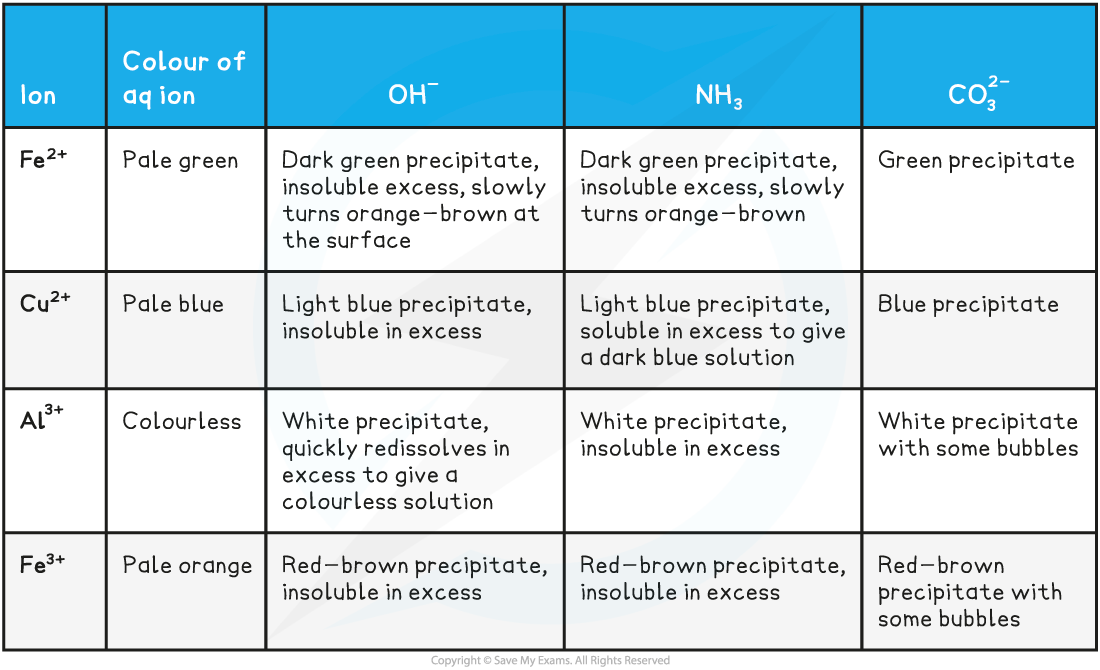
Iron(II)
- The dark green precipitate formed by reaction with hydroxide ions and with ammonia is hydrated iron(II) hydroxide
- This is formed in a two-step process
[Fe(H2O)6]?2+?(aq)??+ OH–?(aq)?→? ??[Fe(H2O)5(OH)]?+?(aq)? + H2O (l)
[Fe(H2O)5(OH)]?+?(aq)??+ OH–?(aq)?→? ??Fe(H2O)4(OH)2?(s)? + H2O (l)
- The ammonia behaves in the same way as sodium hydroxide as it is a base and removes protons from the water ligands; the overall reaction with ammonia is:
[Fe(H2O)6]?2+?(aq)??+ 2NH3?(aq)?→? ??Fe(H2O)4(OH)2??(s)? + 2NH4+?(aq)
- With carbonate ions, the iron(II)carbonate precipitates out:
[Fe(H2O)6]?2+?(aq)??+ CO32-?(aq)?→???FeCO3?(s)? + 6H2O?(l)
Copper(II)
- The light blue precipitate formed by reaction with hydroxide ions is hydrated copper(II) hydroxide
- This is formed in a two-step process
[Cu(H2O)6]?2+?(aq)??+ OH–?(aq)?→? ??[Cu(H2O)5(OH)]?+?(aq)? + H2O (l)
[Cu(H2O)5(OH)]?+?(aq)??+ OH–?(aq)?→? ??Cu(H2O)4(OH)2?(s)? + H2O (l)
- The ammonia initially behaves in the same way as sodium hydroxide as it is a base and removes protons from the water ligands
[Cu(H2O)6]?2+?(aq)??+ 2NH3?(aq)?→? ??Cu(H2O)4(OH)2??(s)? + 2NH4+?(aq)
- However, ammonia is a good ligand and in excess ammonia, the ammonia partially substitutes for water creating the deep blue complex ion, dihydroxytetraaminecopper(II)
Cu(H2O)4(OH)2?(s) + 4NH3?(aq)?→??[Cu(NH3)4(H2O)2??]2+?(aq) + + 2OH-?(aq) + 2H2O?(l)
- With carbonate ions, the copper(II)carbonate precipitates out:
[Cu(H2O)6]?2+?(aq)??+ CO32-?(aq)?→???CuCO3?(s)? + 6H2O?(l)
Aluminium ions
- The white precipitate formed by reaction with hydroxide ions and with ammonia is hydrated aluminium hydroxide
- This is formed in a three-step process
[Al(H2O)6]?3+?(aq)??+ OH–?(aq)?→? ??[Al(H2O)5(OH)]?2+?(aq)? + H2O (l)
[Al(H2O)5(OH)]?2+?(aq)??+ OH–?(aq)?→? ??[Al(H2O)4(OH)2]?+?(aq)? + H2O (l)
[Al(H2O)4(OH)2]?+?(aq)??+ OH–?(aq)?→? ??Al(H2O)3(OH)3?(s)? + H2O (l)
- The ammonia behaves in the same way as sodium hydroxide as it is a base and removes protons from the water ligands; the overall reaction with ammonia is:
[Al(H2O)6]?3+?(aq)??+ 3NH3?(aq)?→? ??Al(H2O)3(OH)3?(s)? + 3NH4+?(aq)
- With carbonate ions, the reaction is a little more complicated
- In the previous section we saw that +3 ions are acidic in water, so the addition of carbonate ions liberates bubbles of carbon dioxide:
2H3O+?(aq)??+ CO32-?(aq)?→???CO2?(g)? + 3H2O?(l)
- The reaction between aluminium and water exists in an equilibrium:
[Al(H2O)6]?3+?(aq) + 3H2O (l)?? ?? ?Al(H2O)3(OH)3??(s)? + 3H3O+?(aq)
- Removal of the hydronium ions by carbonate ions pushes the equilibrium to the right and precipitates out the hydrated aluminium hydroxide
- The overall equation can therefore shown as:
2[Al(H2O)6]3+?+ 3CO32??(aq) → 2Al(H2O)3(OH)3?(s) + 3CO2?(g) + 3H2O (l)
Iron(III)
- The red-brown precipitate formed by reaction with hydroxide ions and with ammonia is hydrated iron(III) hydroxide
- This is formed in a three-step process
[Fe(H2O)6]?3+?(aq)??+ OH–?(aq)?→? ??[Fe(H2O)5(OH)]?2+?(aq)? + H2O (l)
[Fe(H2O)5(OH)]?2+?(aq)??+ OH–?(aq)?→? ??[Fe(H2O)4(OH)2]?+?(aq)? + H2O (l)
[Fe(H2O)4(OH)2]?+?(aq)??+ OH–?(aq)?→? ??Fe(H2O)3(OH)3?(s)? + H2O (l)
- The ammonia behaves in the same way as sodium hydroxide as it is a base and removes protons from the water ligands; the overall reaction with ammonia is:
[Fe(H2O)6]?3+?(aq)??+ 3NH3?(aq)?→? ??Fe(H2O)3(OH)3?(s)? + 3NH4+?(aq)
- With carbonate ions, the reaction is the same as with aluminium; the acidity of iron(III) ions removes the carbonate ion and produces bubbles of carbon dioxide, while the iron(III) precipitates out as the hydroxide
[Fe(H2O)6]?3+?(aq) + 3H2O (l)?? ?? ?Fe(H2O)3(OH)3??(s)? + 3H3O+?(aq)
- The overall equation can therefore shown as:
2[Fe(H2O)6]3+?(aq)? + 3CO32??(aq) → 2Fe(H2O)3(OH)3?(s) + 3CO2?(g) + 3H2O (l)
Exam Tip
Transition metals in the +3 state are acidic and do not form carbonate precipitates, unlike the +2 ions.
Amphoteric Hydroxides
- Aluminium hydroxide is classified as an?amphoteric hydroxide
- The word amphoteric means it reacts with both acids and bases
- Aluminium hydroxide is insoluble in water but readily dissolves in dilute hydrochloric acid producing the hexaaquaaluminium ion:
Al(OH)3(H2O)3?(s)? ? + 3HCl?(aq)? ??→? ??[Al(H2O)6]?3+?(aq)? + 3Cl-?(aq)
- Aluminium hydroxide dissolves in sodium hydroxide to form sodium tetrahydoxoaluminate
Al(OH)3(H2O)3?(s)? ? + NaOH (aq)? ??→? ?Na?[Al(OH)4]?(aq)? + 3H2O?(l)
- The same equation may be shown ionically as:
Al(OH)3(H2O)3?(s)? ? + OH-?(aq)? ??→? ??[Al(OH)4]?-?(aq)? + 3H2O?(l)
- You need a strong base to carry out the reaction, so it is usually done with hot concentrated sodium hydroxide
Exam Tip
You can also show the reactions with sodium hydroxide as:Al(OH)3?+ NaOH → NaAl(OH)4orAl(OH)3(H2O)3?+ OH–?→ [Al(OH)4(H2O)2]–?+ H2OorAl(OH)3?+ OH–?→ [Al(OH)4]–
轉載自savemyexams
以上就是關于【AQA A Level Chemistry復習筆記6.3.2 Reactions with Bases】的解答,如需了解學校/賽事/課程動態,可至翰林教育官網獲取更多信息。
往期文章閱讀推薦:
MIT官方發布【2026年夏季推薦閱讀書單】!橫跨科學/人文/經濟...


翰林AMC8視頻課重磅上線!

國際競賽真題資源免費領取






