AQA A Level Chemistry復習筆記3.4.5 Addition Polymers

Addition Polymers
Addition polymerisation
- Addition polymerisation?is one of the most important addition reactions of alkenes which form the basis of the plastics industry
- Addition polymerisation is the reaction in which many?monomers?containing at least one C=C double bond form long chains of?polymers?as the only product
- Just like in other addition reactions of alkenes, the π-bond in each C-C bond breaks and then the monomers link together to form new C-C single bonds
- A?polymer?is a long-chain molecule that is made up of many repeating units
- The small, reactive molecules that join together to form the polymer are called?monomers
- A polymerisation reaction can be represented by a?general formula?or by using?displayed formulae
- Eg. poly(ethene) and poly(chloroethene) (also known as?PVC) are polymers made up of the ethene and chloroethene monomers respectively and are commonly used in making plastics
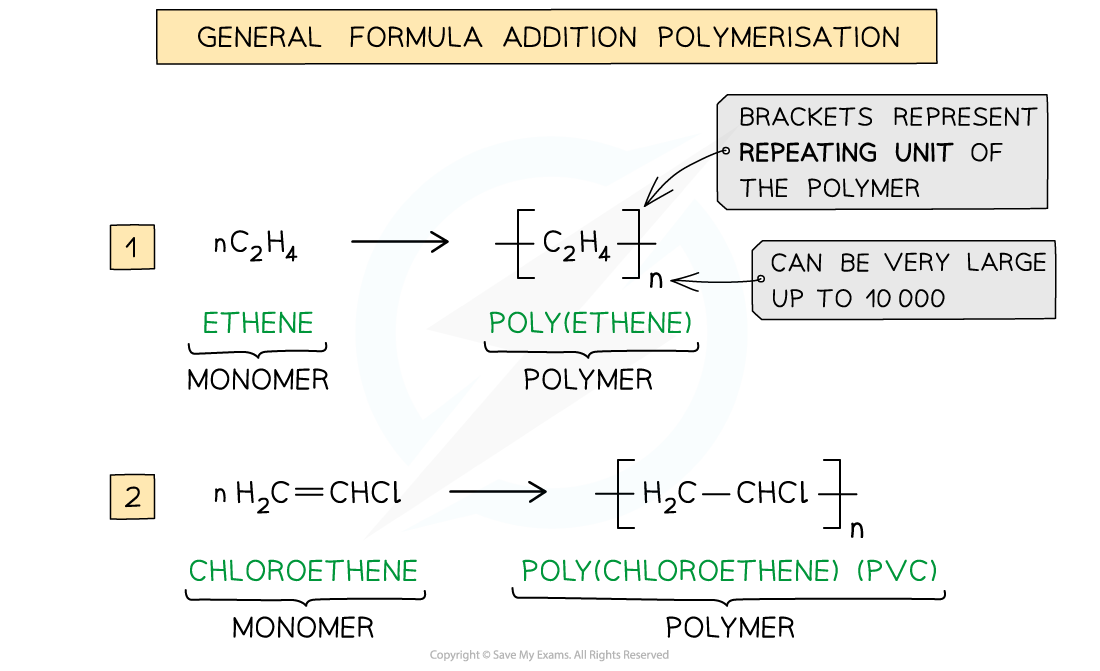
The general formulae of the addition polymerisation of ethene (1) and chloroethene (2)
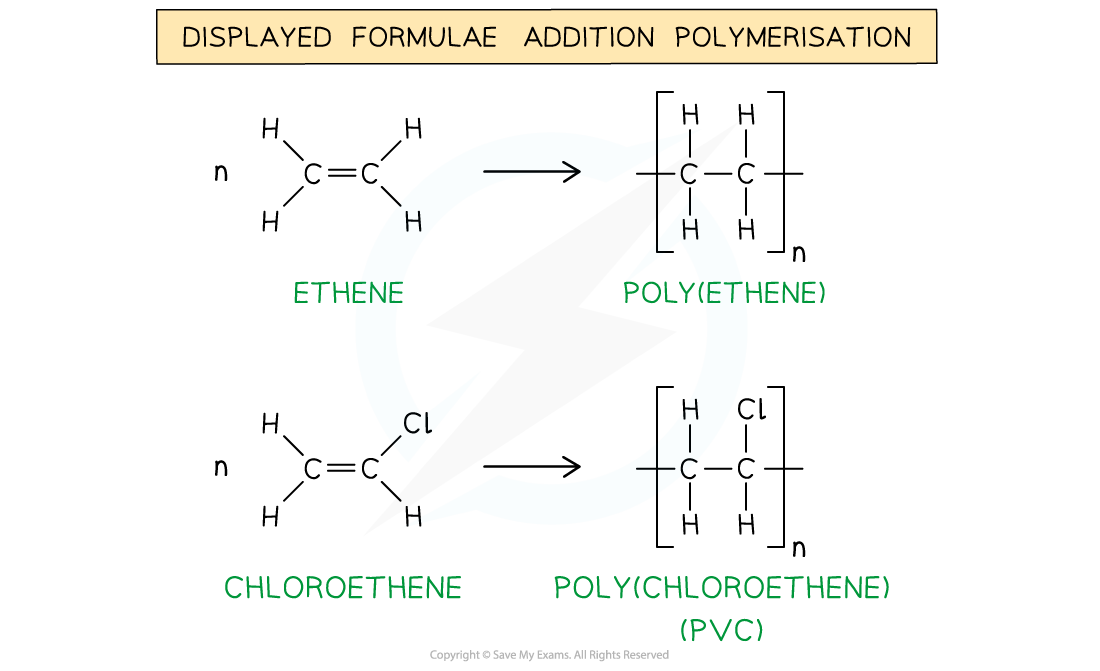
The displayed formulae of the addition polymerisation of ethene (1) and chloroethene (2)
- Just like any other?addition?reaction of alkenes, addition polymerisation gives only?one?product
Deducing repeat units
- A?repeat unit?is the smallest group of atoms that when connected one after the other make up the polymer chain
- It is represented by?square brackets?in the displayed and general formula
- In?poly(alkenes)?(such as poly(ethene)) and?substituted poly(alkenes)?(such as PVC) made of?one type of monomer?the repeating unit is the same as the monomer except that the C=C double bond is changed to a C-C single bond
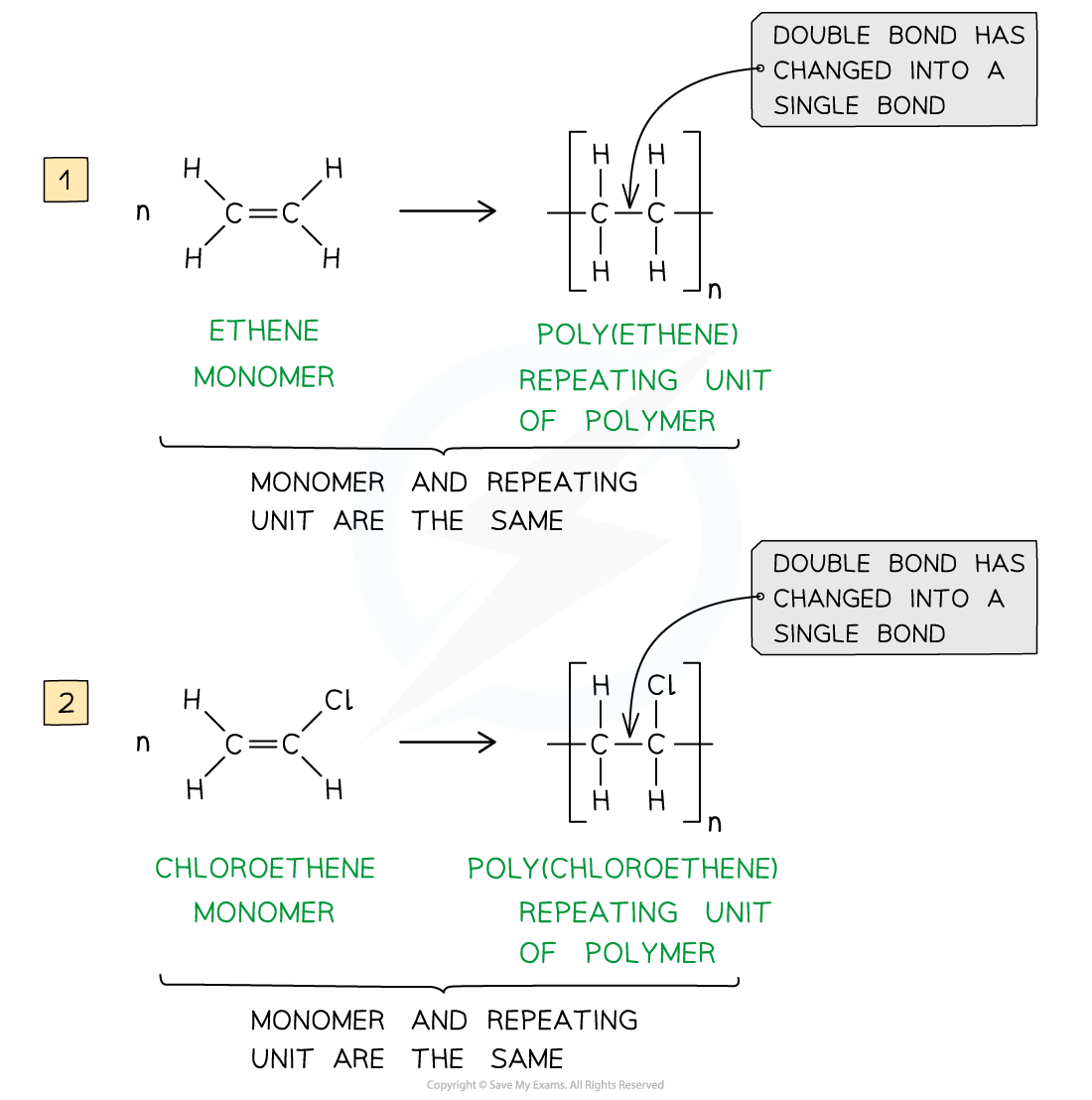
The repeating units of poly(ethene) and poly(chloroethene) are similar to their monomer except that the C=C bond has changed into a C-C bond
Worked Example
Identifying monomersIdentify the monomers present in the given sections of addition polymer molecules: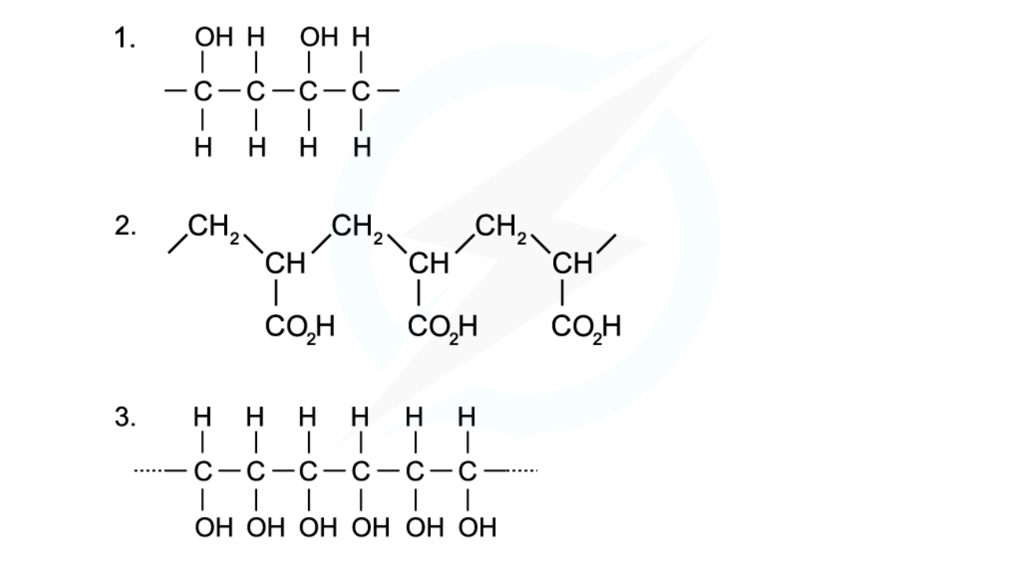
Answer 1:
-
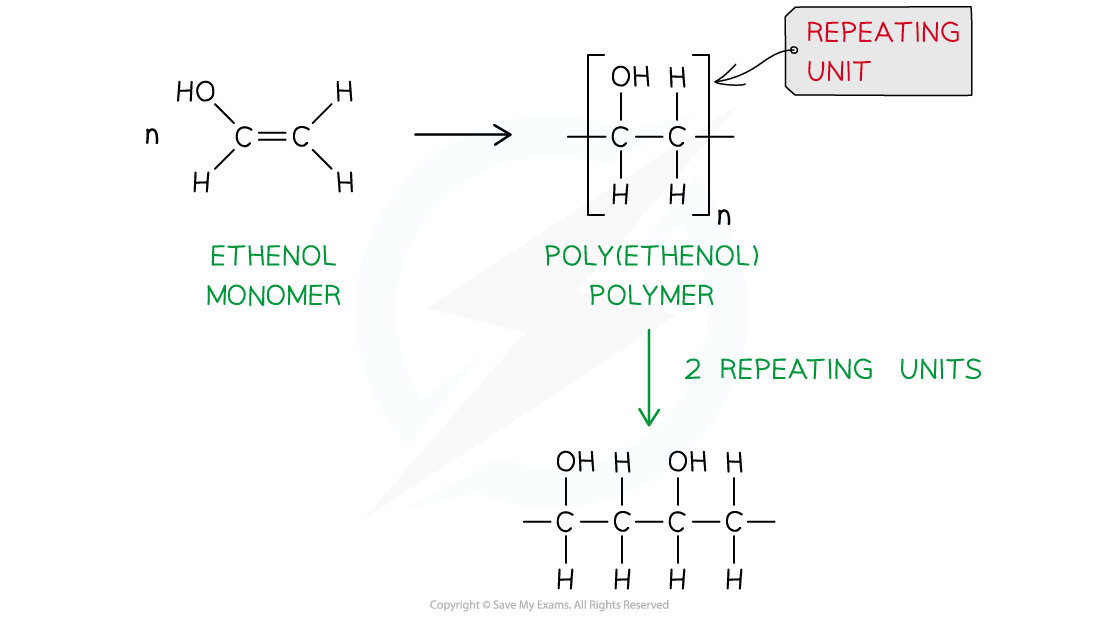
- When ethenol, CH(OH)=CH2, is polymerised, the C=C double bond opens to produce a repeating unit of -CH(OH)-CH2- This gives the polymer poly(ethenol)
Answer 2:
-
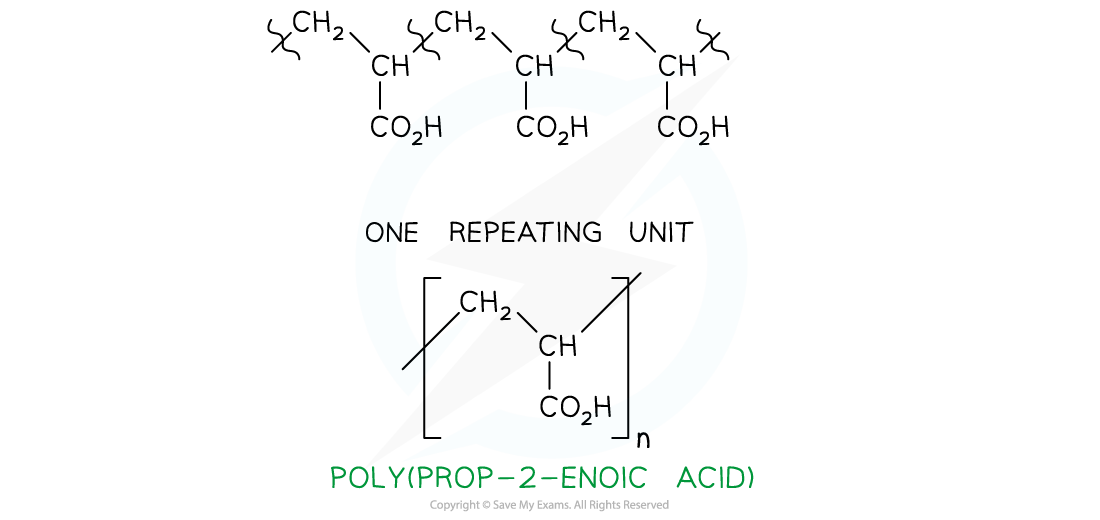
- To find the monomer, first the repeating unit should be deduced. Repeating units have only 2 carbons in the polymer main chain
-
- Since the repeating unit is now found, it can be concluded that the monomer is prop-2-enoic acid

Answer 3:
-
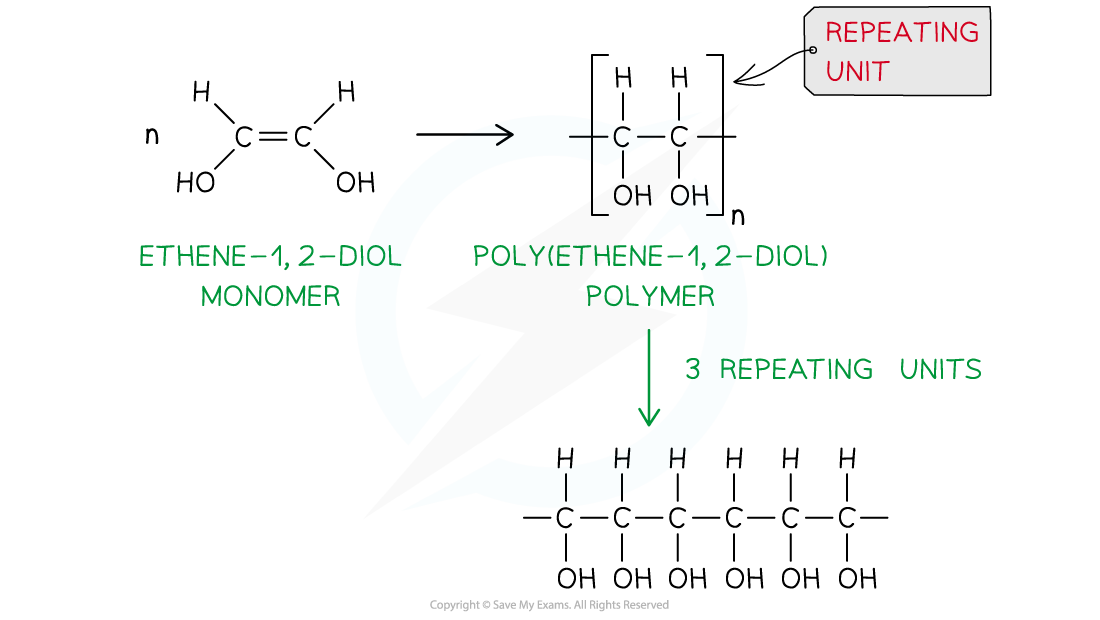
- Again, the repeating unit only has 2 carbons in the polymer chain which in this case are two carbon atoms that each contain one OH group
- Thus, when ethene-1,2-diol, CH(OH)=CH(OH), is polymerised, the C=C double bond opens to produce a repeating unit of? -CH(OH)-CH(OH)- which gives the polymer poly(ethene-1,2-diol)
Exam Tip
The section of the polymer chain shown inside the square brackets by the structural or displayed formula is the?repeat unit?and?not?the monomerThe monomer is the same as the repeat unit except for that it has C=C bonds instead of C-C bonds
轉載自savemyexams
以上就是關于【AQA A Level Chemistry復習筆記3.4.5 Addition Polymers】的解答,如需了解學校/賽事/課程動態,可至翰林教育官網獲取更多信息。
往期文章閱讀推薦:
2026 ALEVEL 夏考A率出爐!愛德思vs牛津AQA,哪些科目真的“好出分”?
2026 AMC10/12美國數學競賽新賽季!【翰林教育 × 清華大學出版社】獨家教材全面發售!


翰林AMC8視頻課重磅上線!

國際競賽真題資源免費領取






