AQA A Level Chemistry復習筆記1.1.5 Electron Configuration

Deducing the Electron Configuration
- The Periodic Table is split up into four main blocks depending on their electron configuration
- Elements can be classified as an s-block element, p-block element and so on, based on the position of the outermost electron:
- s block elements
- Have their valence electron(s) in an s orbital
- p block elements
- Have their valence electron(s) in a p orbital
- d block elements
- Have their valence electron(s) in a d orbital
- f block elements
- Have their valence electron(s) in an f orbital
- s block elements
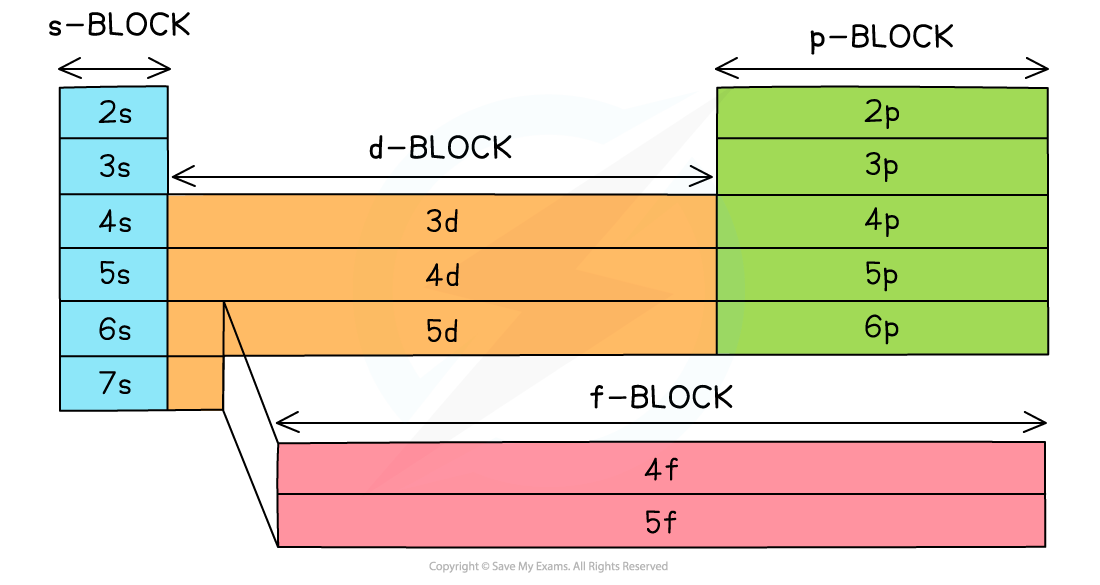
- The?principal quantum shells?increase in energy with increasing?principal quantum number
- E.g.?n?= 4 is higher in energy than?n?= 2
- The?subshells?increase in energy as follows: s < p < d < f
- The only exception to these rules is the 3d orbital which has slightly higher energy than the 4s orbital
- Because of this, the 4s orbital is filled before the 3d orbital
- All the orbitals in the?same?subshell have the same energy and are said to be?degenerate
- E.g. px, py?and pz?are all equal in energy
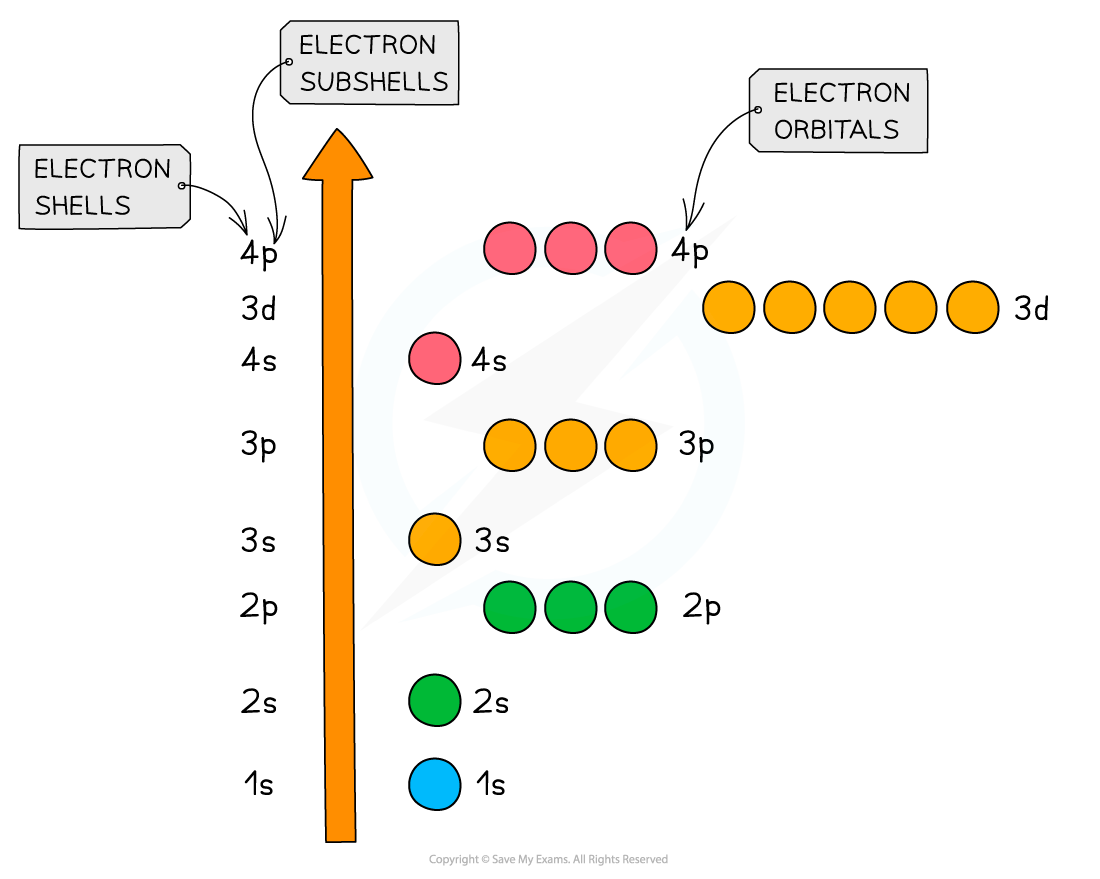
Relative energies of the shells and subshells
- The?electron configuration?gives information about the number of electrons in each?shell, subshell?and?orbital?of an atom
- The subshells are filled in order of increasing energy
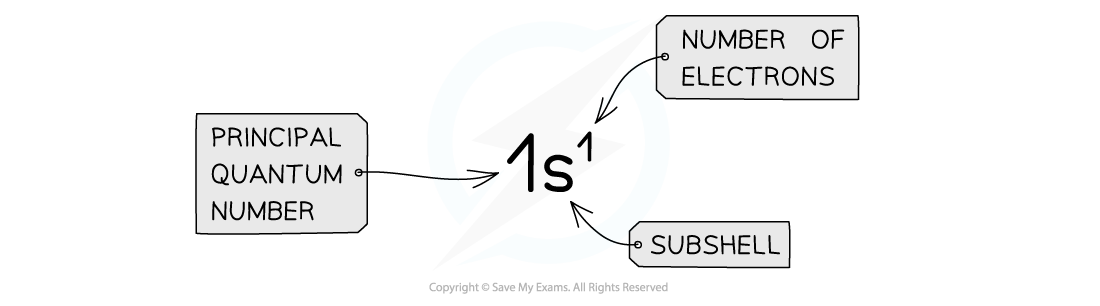
The electron configuration shows the number of electrons occupying a subshell in a specific shell
- Writing out the?electron?configuration?tells us how the electrons in an atom or ion are arranged in their shells, subshells and orbitals
- This can be done using the?full?electron configuration or the?shorthand?version
- The?full?electron configuration describes the arrangement of all electrons from the 1s subshell up
- The?shorthand?electron configuration includes using the symbol of the?nearest preceding?noble?gas?to account for however many electrons are in that noble gas
- Ions?are formed when atoms?lose?or?gain?electrons
- Negative ions are formed by?adding?electrons to the outer subshell
- Positive ions are formed by?removing?electrons from the outer subshell
- The transition metals?fill?the 4s subshell before the 3d subshell but?lose?electrons from the 4s first and not from the 3d subshell (the 4s subshell is lower in energy
Full Electron Configurations
- Hydrogen has 1 single electron
- The electron is in the s orbital of the first shell
- Its electron configuration is 1s1
- Potassium has 19 electrons
- The first 2 electrons fill the s orbital of the first shell
- They then continue to fill subsequent orbitals and subshells in order of increasing energy
- The 4s orbital is lower in energy than the 3d subshell, so it is therefore filled first
- The full electron configuration of potassium is?1s2?2s2?2p6?3s2?3p6?4s1
Shorthand Electron Configurations
- Using potassium as an example again:
- The nearest preceding noble gas to potassium is?argon
- This accounts for 18 electrons of the 19 electrons that potassium has
- The shorthand electron configuration of potassium is?[Ar] 4s1
Worked Example
Write down the full and shorthand electron configuration of the following elements:
- ? Calcium
- ? Gallium
- ? Ca2+
Answer
Answer 1:
-
- Calcium has 20 electrons so the?full?electronic?configuration is:
1s2?2s2?2p6?3s2?3p6?4s2
-
- The 4s orbital is lower in energy than the 3d subshell and is therefore filled first
- The?shorthand?version is [Ar] 4s2?since argon is the nearest preceding noble gas to calcium which accounts for 18 electrons
Answer 2:
-
- Gallium has 31 electrons so the?full?electronic?configuration is:
1s2?2s2?2p6?3s2?3p6?3d10?4s2?4p1
[Ar] 3d10?4s2?4p1
-
- Even though the 4s is filled first, the full electron configuration is often written in numerical order. So, if there are electrons in the 3d sub-shell, then these will be written before the 4s
Answer 3:
-
- What this means is that if you ionise calcium and remove two of its outer electrons, the electronic configuration of the Ca2+ ion is identical to that of argon
Ca2+?is 1s2?2s2?2p6?3s2?3p6
Ar?is also 1s2?2s2?2p6?3s2?3p6
Exceptions
- Chromium and copper have the following electron configurations, which are different to what you may expect:
- Cr is [Ar] 3d5?4s1?not?[Ar] 3d4?4s2
- Cu is [Ar] 3d10?4s1?not?[Ar] 3d9?4s2
- This is because the [Ar] 3d5?4s1?and [Ar] 3d10?4s1?configurations are?energetically stable
Presenting the Electron Configuration
- Electrons can be imagined as small?spinning charges?which rotate around their own axis in either a?clockwise?or?anticlockwise direction
-
- The spin of the electron is represented by its direction
- Electrons with similar?spin?repel each other which is also called?spin-pair repulsion
- Electrons will therefore occupy separate orbitals in the same subshell where possible, to minimize this repulsion and have their?spin?in the same direction
- E.g. if there are three electrons in a?p subshell, one electron will go into each px, py?and pz?orbital

Electron configuration: three electrons in a p subshell
- Electrons are only paired when there are no more empty orbitals available within a subshell, in which case the spins are the?opposite?spins to minimize repulsion
- E.g. if there are four electrons in a p subshell, one p orbital contains 2 electrons with opposite spin and two orbitals contain one electron only
- The first 3 electrons fill up the empty p orbitals one at a time, and then the 4th one pairs up in the?px?orbital

Electron configuration: four electrons in a p subshell
Box Notation
- The?electron configuration?can be represented using the?electrons in boxes?notation
- Each box represents an?atomic orbital
- The boxes are arranged in order of?increasing?energy from bottom to top
- The electrons are represented by opposite arrows to show the?spin?of the electrons
- E.g. the box notation for titanium is shown below
- Note that since the 3d subshell cannot be either full or half full, the second 4s electron is not promoted to the 3d level and stays in the 4s orbital

The electrons in titanium are arranged in their orbitals as shown. Electrons occupy the lowest energy levels first before filling those with higher energy
Exam Tip
You can use full headed arrows or half headed arrows to represent electrons in your box notations.
轉載自savemyexams
以上就是關于【AQA A Level Chemistry復習筆記1.1.5 Electron Configuration】的解答,如需了解學校/賽事/課程動態,可至翰林教育官網獲取更多信息。
往期文章閱讀推薦:
2026 ALEVEL 夏考A率出爐!愛德思vs牛津AQA,哪些科目真的“好出分”?
2026 AMC10/12美國數學競賽新賽季!【翰林教育 × 清華大學出版社】獨家教材全面發售!


翰林AMC8視頻課重磅上線!

國際競賽真題資源免費領取






