Edexcel IGCSE Biology 復習筆記 2.9.1 Excretion

Edexcel IGCSE Biology 復習筆記 2.9.1 Excretion
The Need for Excretion in Humans
- Many of the necessary?metabolic reactions?that take place within the cells of organisms produce?waste products
- Excretion?is the?removal of the waste substances?of metabolic reactions,?toxic materials?and?substances in excess?of requirements
- Metabolic wastes produced by the human body include:
- Carbon dioxide?and?water?from aerobic respiration in cells
- Urea?produced by the breakdown of excess proteins (amino acids) in the liver
- Other?substances in excess?such as medical drugs (e.g. antibiotics) and dietary minerals (e.g. sodium)
The danger of waste products
- If waste products are allowed to build up they can have a range of negative effects on the body:
- Toxicity?- waste products can have?toxic effects?if they are allowed to reach?high concentrations
- ?Carbon dioxide?dissolves in water easily to form an acidic solution which can?lower the pH of cells.?This can?reduce the activity of enzymes?in the body which are essential for controlling the rate of metabolic reactions
- Osmotic?effect - body fluids can become?more concentrated?due to higher amounts of waste products
- Concentrated body fluids can cause water to move out of cells, changing their water potential and preventing them from carrying out essential reactions
- Using up necessary?storage?- space within an organism is limited and is required for the storage of more useful molecules
- Toxicity?- waste products can have?toxic effects?if they are allowed to reach?high concentrations
Exam Tip
Be careful not to get confused between excretion and egestion, they are two very different things!Egestion is the expulsion of food that has?never been absorbed?from the body (as faeces) via the anus.
The Need for Excretion in Plants
- Within plant cells there is a range of metabolic reactions taking place producing waste products
- Some of these waste products can be used up in other processes in the plant while some must exit the plant via the?leaf organ
- Waste products or substances in excess within a plant can include:
- Oxygen
- Carbon dioxide
- Water/water vapour
- Other unwanted chemical substances
Oxygen and carbon dioxide
- Oxygen and carbon dioxide?can be both reactants and waste products within a plant
- The amount or?intensity of light?affects the waste products within plants
- During the?day, when there is?sufficient light:
- The rate of photosynthesis is?higher?than the rate of respiration
- More oxygen is released than used in respiration
- Less carbon dioxide is released than used in photosynthesis
- Net effect -?oxygen is in excess?and a waste product
- During the?night, when there is?insufficient light:
- There is?no?photosynthesis,?only?respiration
- Oxygen is used in respiration and carbon dioxide is produced
- No photosynthesis means that no carbon dioxide is used
- Net effect -?carbon dioxide is in excess?and a waste product
- Whichever gas is in excess?diffuses out?of the plant via the?leaf organ
- The gases exit through the?stomata
- As the excretion of gases in plants occurs via?diffusion?it is technically not an active process
Water vapour
- The majority of water vapour lost from a plant is?not a waste product of metabolism, but instead water that has been drawn up from the roots in the?transpiration stream
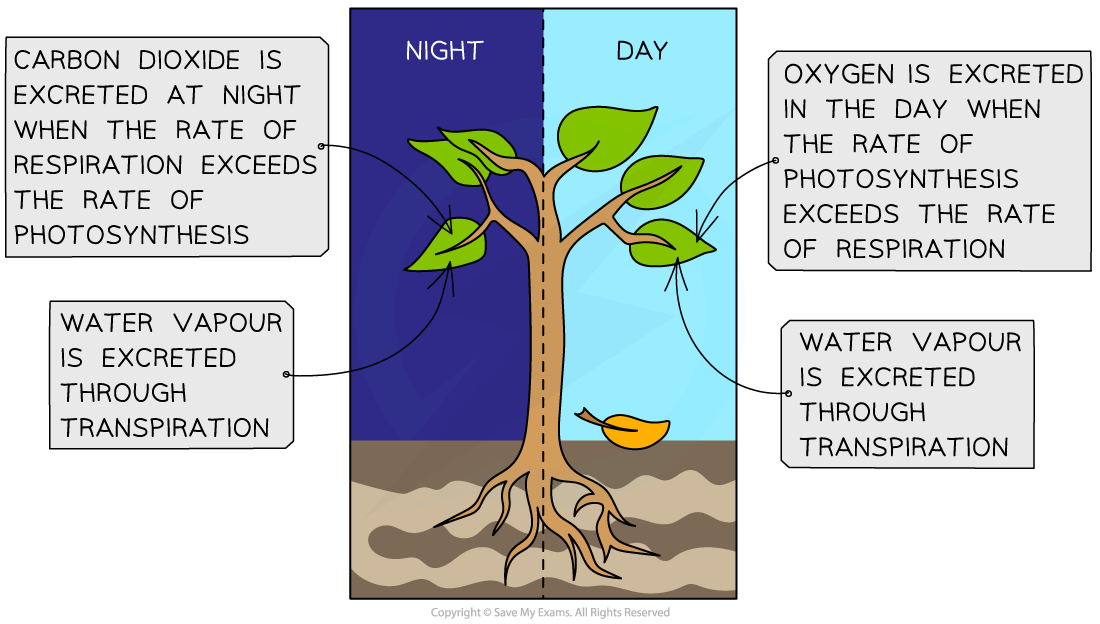
Excretion in plants during the daytime compared to night time
Chemical substances
- Plant cells can?break down?molecules into chemical substances no longer required by the plant
- Some of these substances?cannot?be converted into another useful compound and so must be removed from the plant
- Chemical waste materials such as this can be?stored in the dying tissues?of a plant
- When the dying tissue falls off the plant the substances are removed
- E.g. in autumn the leaves of deciduous trees turn a variety of colours due to the presence of chemical waste products
轉載自savemyexam
以上就是關于【Edexcel IGCSE Biology 復習筆記 2.9.1 Excretion】的解答,如需了解學校/賽事/課程動態,可至翰林教育官網獲取更多信息。
往期文章閱讀推薦:
IGCSE全A*,A-Level階段卻崩了?別忽視IGCSE選課的重要性!
2026 CAIE IGCSE 夏季大考放榜!A* 線全面揭曉,今年真的卷到新高度?


翰林AMC8視頻課重磅上線!

國際競賽真題資源免費領取






