AQA A Level Biology復(fù)習(xí)筆記2.4.5 Osmosis

The Process of Osmosis
- All cells are surrounded by a cell membrane which is?partially permeable
- Water can move in and out of cells by?osmosis
- Osmosis is the?diffusion of water molecules?from a dilute solution (high concentration of water) to a more concentrated solution (low concentration of water) across a partially permeable membrane
- In doing this, water is moving down its concentration gradient
- The cell membrane is partially permeable which means it allows small molecules (like water) through but not larger molecules (like solute molecules)
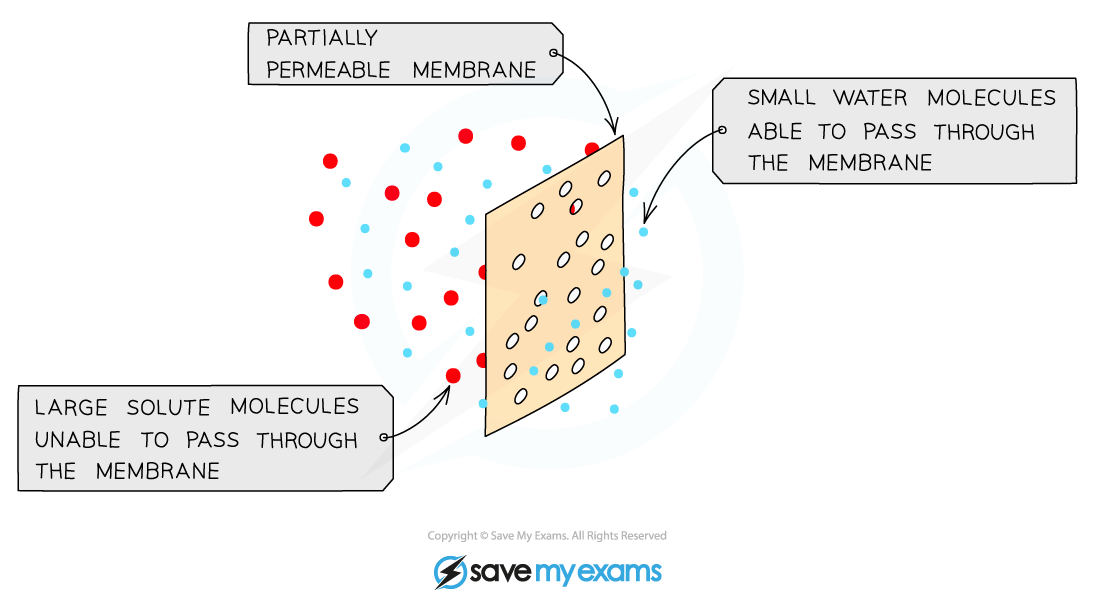
Osmosis and the partially permeable membrane
- Osmosis is the?net movement of water molecules?from a region of?higher water potential?(dilute solution) to a region of?lower water potential?(concentrated solution), through a partially permeable membrane
- Water potential describes the tendency of water to move out of a solution. This term is used to avoid confusion between water concentration and concentration of a solution
- A dilute solution has a high water potential (the right-hand side of the diagram below) and a concentrated solution has a low water potential (the left-hand side of the diagram below)
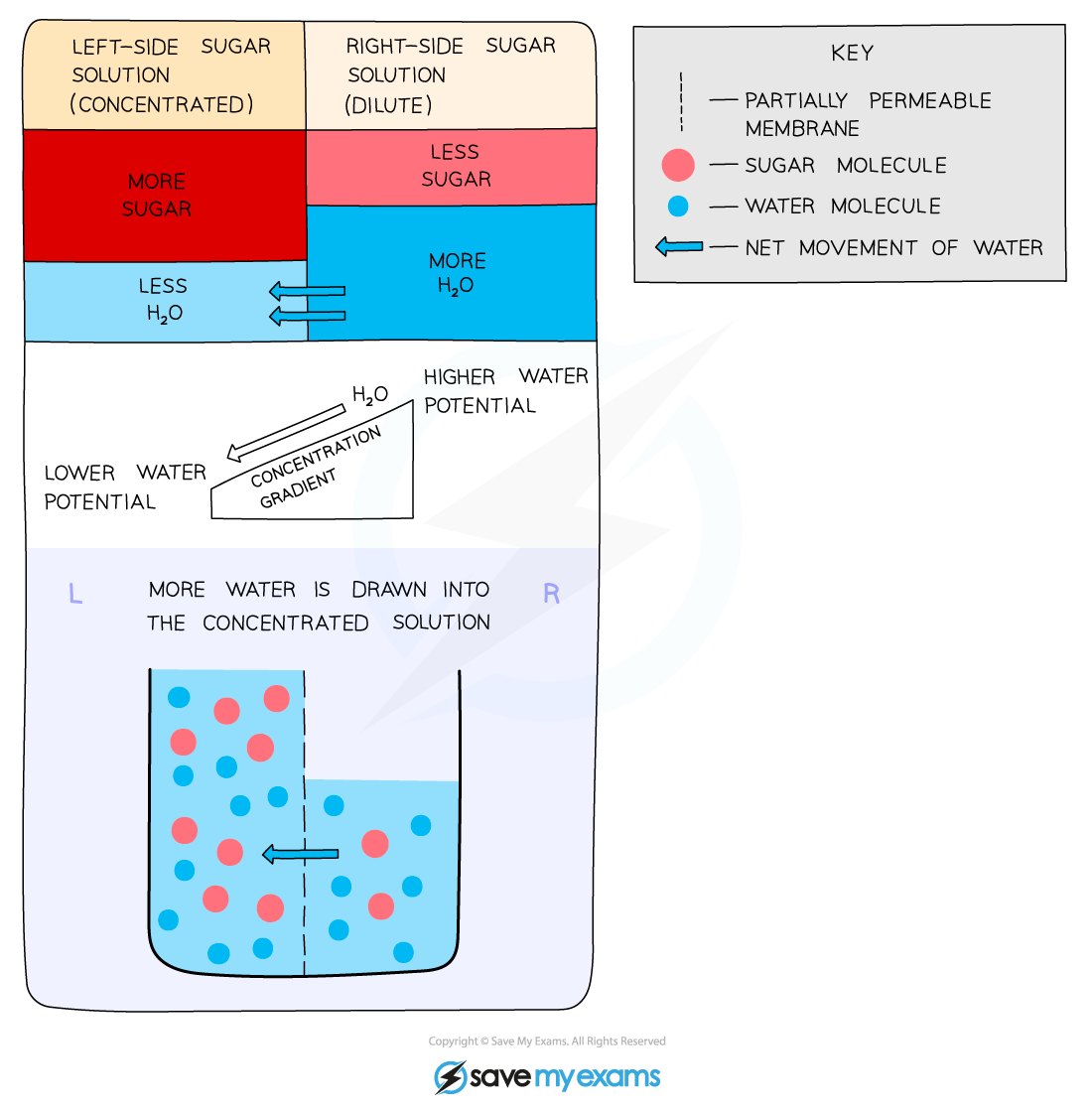
How osmosis works
- The?water potential?of?pure water?(without any solutes) at atmospheric pressure is?0kPa, therefore any solution that has solutes will have a water potential lower than 0kPa (it will be a?negative?value)
Exam Tip
Water can pass through the phospholipid bilayer because water molecules are small molecules that can pass between phospholipids in the cell membrane. Although water molecules are polar, they can still pass through the bilayer because of their small size.When interpreting questions on water potential, remember – the?more negative?the water potential, the?lower?the?water potential?(the further it is away from pure water which has a water potential of 0 kPa).
轉(zhuǎn)載自savemyexams
以上就是關(guān)于【AQA A Level Biology復(fù)習(xí)筆記2.4.5 Osmosis】的解答,如需了解學(xué)校/賽事/課程動(dòng)態(tài),可至翰林教育官網(wǎng)獲取更多信息。
往期文章閱讀推薦:
斯坦福大學(xué)官方推薦書單!名校學(xué)霸們暑假都在讀什么?
MIT官方發(fā)布【2026年夏季推薦閱讀書單】!橫跨科學(xué)/人文/經(jīng)濟(jì)...


翰林AMC8視頻課重磅上線!

國(guó)際競(jìng)賽真題資源免費(fèi)領(lǐng)取






