AQA A Level Biology復習筆記2.3.9 Viral Particle Replication

Viruses Do Not Undergo Cell Division
- Viruses?are?non-cellular infectious particles?that straddle the boundary between ‘living’ and ‘non-living’
- They are?much smaller?than?prokaryotic cells
- They are typically between 20 and 300 nm in diameter
- For example, the Human Immunodeficiency Virus (HIV) is about 100 nm (0.1 μm) in diameter
- Viruses are relatively?simple in structure
- Unlike prokaryotic cells, they?do not have?a plasma membrane, cytoplasm or ribosomes
- Structurally they have:
- A?nucleic acid core?(their genomes are either DNA or RNA, and can be single or double-stranded)
- A?protein coat?known as a?‘capsid’
- Some viruses have an outer layer known as an?‘envelope’?formed usually from the membrane-phospholipids of a cell they were made in

Viruses are not cellular like prokaryotes and eukaryotes – this is an example of a typical structure of a virus
Viral replication
- Being non-living, viruses?do not undergo cell division
- All viruses are?parasitic, meaning they can?only reproduce?by infecting living cells (known as?host cells)
- Viruses replicate by?injecting their nucleic acid?into a host cell:
- First, a virus uses?attachment proteins?on its surface to bind to?complementary receptor proteins?on the surface of a host cell
- The virus then?injects?its?DNA?or?RNA?into the host cell
- The host cell then uses its nucleic acid and protein-building machinery (ribosomes) to produce?new viral particles
- Eventually, the new viral particles are?released. This may occur when:
- The host cell?bursts?open, releasing all the new viral particles at once
- Viral particles leave individually through the host cell membrane via a process known as?‘budding’, often taking a section of the membrane with them (this is the ‘envelope’ that surrounds some viruses)
- The exiting of viruses?damages?their host cells, causing?disease
- For example, HIV infects cells of the immune system (such as helper T cells and macrophages)
- When the newly replicated HIV particles exit, these host cells are destroyed
- Over time, the immune system becomes severely compromised and this eventually leads to Acquired Immunodeficiency Syndrome (AIDS)
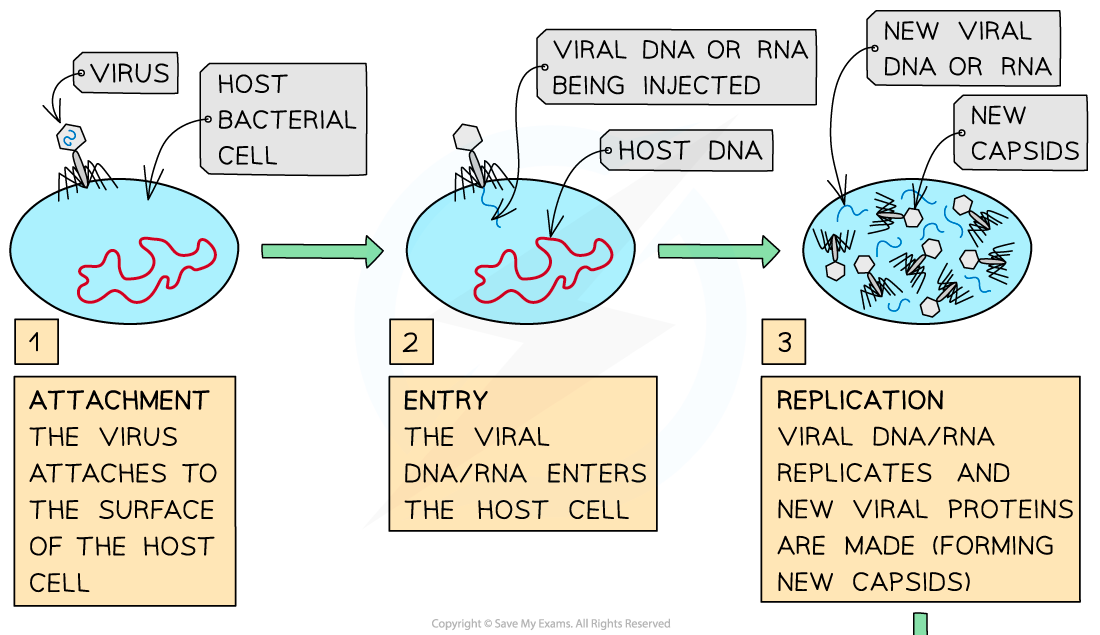
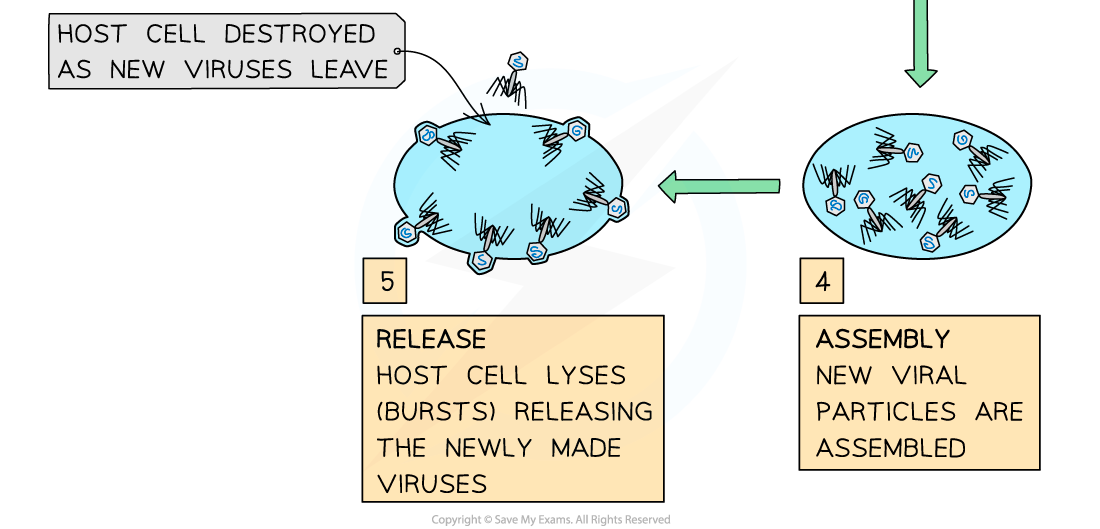
The process of viral replication - in this case, the virus is a bacteriophage (a virus that infects specific prokaryotic host cells)
Exam Tip
Different viruses have different attachment proteins and therefore can only bind to specific host cell types that have the correct (complementary) receptor proteins. For example, some viruses use prokaryotic host cells, whilst others use eukaryotic animal or plant host cells. In addition, some viruses can only infect one specific cell type, whereas others can infect many different cell types.
轉(zhuǎn)載自savemyexams
以上就是關于【AQA A Level Biology復習筆記2.3.9 Viral Particle Replication】的解答,如需了解學校/賽事/課程動態(tài),可至翰林教育官網(wǎng)獲取更多信息。
往期文章閱讀推薦:
2026 ALEVEL 夏考A率出爐!愛德思vs牛津AQA,哪些科目真的“好出分”?
2026 AMC10/12美國數(shù)學競賽新賽季!【翰林教育 × 清華大學出版社】獨家教材全面發(fā)售!


翰林AMC8視頻課重磅上線!

國際競賽真題資源免費領取






