AQA A Level Biology復(fù)習(xí)筆記1.4.4 Required Practical: Measuring Enzyme Activity

Required Practical: Measuring Enzyme Activity
- The?progress?of?enzyme-catalysed reactions?can be investigated by:
- Measuring the?rate of formation of a product?using catalase
- Measuring the?rate of disappearance of a substrate?using amylase
Investigating catalase activity
- In this investigation, the rate of?product formation?is used to measure the rate of an enzyme-controlled reaction:
- Hydrogen peroxide?is a common but?toxic?by-product of metabolism
- This means it must be?broken down?quickly
- Catalase?is an enzyme found in the cells of most organisms that?breaks down hydrogen peroxide into water and oxygen
- Hydrogen peroxide and catalase are combined and the?volume of oxygen generated?is measured in a set time
- The?rate of reaction?can then be calculated
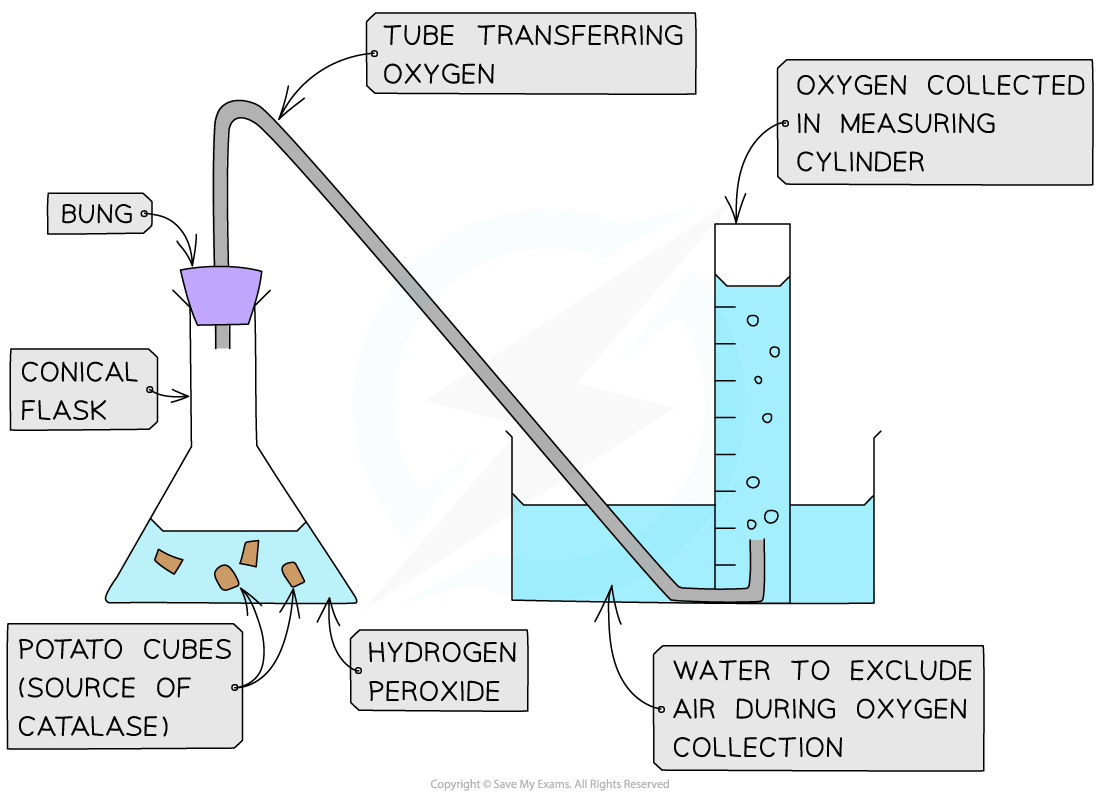
Experimental set-up for investigating the rate of formation of a product using catalase
Investigating amylase activity using iodine
- In this investigation, the rate of?substrate disappearance?is used to compare rates of reaction under different conditions
- Amylase?is a digestive enzyme that?hydrolyses starch into maltose and glucose
- Amylase functions best at pH 7 and 37oC (all enzymes operate best under specific conditions)
- Amylase and starch are combined?and this reaction mixture is then?tested for starch?at regular time intervals
- This can be done by taking samples from the reaction mixture at each time interval and adding each sample to some?iodine in potassium iodide solution
- Starch forms a?blue-black?colour with this solution
- If no starch is present, the iodine solution remains yellow-brown
- In this way, the time taken for starch to be broken down can be measured
- The investigation can be repeated under a variety of conditions?(eg. by altering pH, temperature, enzyme concentration or starch concentration) and the?reaction rates can then be compared
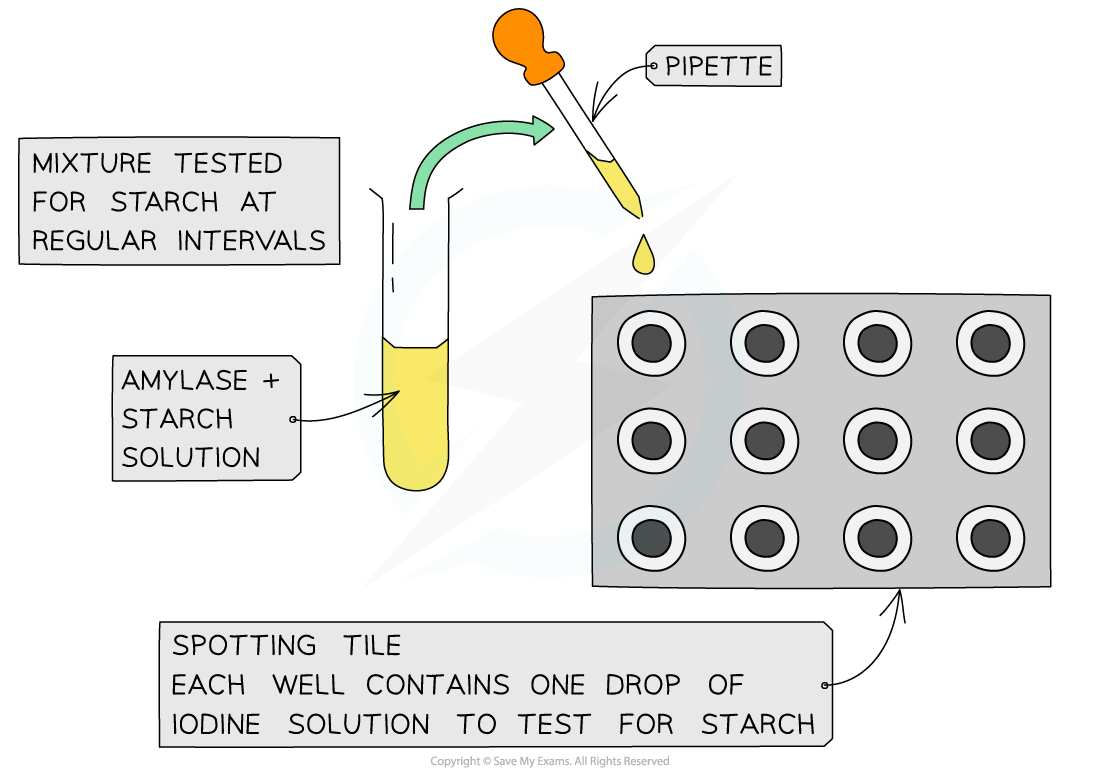
Experimental set-up for investigating the rate of disappearance of a substrate using amylase
Investigating the effect of starch concentration on amylase activity using colourimetry
- A?colourimeter?is able to measure?light absorbance?(how much light is absorbed) or?light transmission?(how much light passes through) a substance
- Colourimetry can be used in any enzyme-catalysed reaction that involves colour change
- As the colour breaks down the?transmission increases?or?light absorption decreases?and this can be used to?measure the rate of the reaction
- For example, a colourimeter can be used to follow the progress of a?starch-amylase catalysed reaction?as the amylase breaks the starch down into maltose
- This can be carried out as follows:
- Colourimeter calibration: this is an important step in a colourimetric investigation and in this case a weak iodine solution can be used to calibrate the colourimeter as the end point (or 100% transmission)
- Preparation of a starch solution of?known concentration?(stock solution), from which a range of concentrations are made using?serial dilutions?(method outlined in diagram below)
- Following calibration and switching on the red filter (to maximise the percentage transmission or absorbance), the colourimeter is used to?measure the percentage absorbance or percentage transmission values
- Sometimes a reagent or indicator is used to produce the colours detected by the colourimeter and sometimes the solutions themselves absorb light waves
- A?calibration graph?is then plotted of starch concentration (X-axis) vs percentage absorbance or percentage transmission (Y-axis)
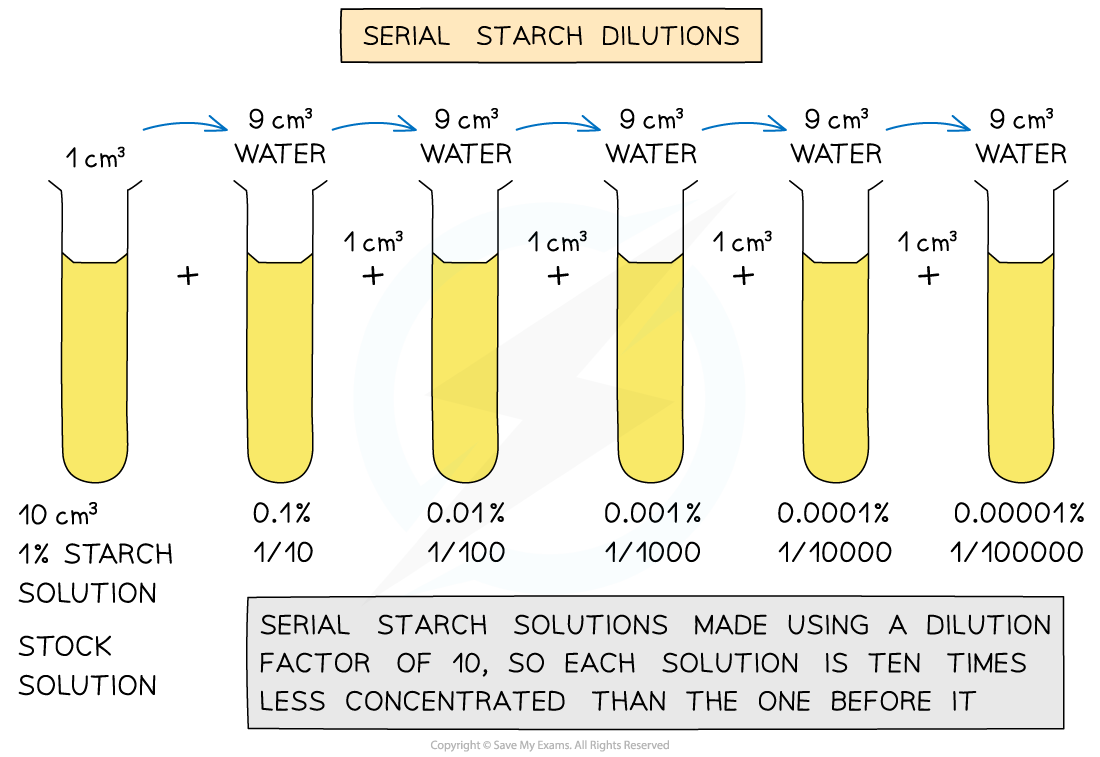
Serial dilution of starch to make a range of concentrations
轉(zhuǎn)載自savemyexams
以上就是關(guān)于【AQA A Level Biology復(fù)習(xí)筆記1.4.4 Required Practical: Measuring Enzyme Activity】的解答,如需了解學(xué)校/賽事/課程動(dòng)態(tài),可至翰林教育官網(wǎng)獲取更多信息。
往期文章閱讀推薦:
斯坦福大學(xué)官方推薦書(shū)單!名校學(xué)霸們暑假都在讀什么?
MIT官方發(fā)布【2026年夏季推薦閱讀書(shū)單】!橫跨科學(xué)/人文/經(jīng)濟(jì)...


翰林AMC8視頻課重磅上線!

國(guó)際競(jìng)賽真題資源免費(fèi)領(lǐng)取






