SASMO競賽七年級(初中一年級)樣題及答案

新加坡國際奧林匹克數(shù)學(xué)學(xué)術(shù)活動?(SINGAPORE & ASIAN SCHOOLS MATH OLYMPIAD),簡稱?SASMO,創(chuàng)立于2006年,是新加坡國際數(shù)學(xué)學(xué)術(shù)活動中心 SIMCC 主辦的其中一項國際數(shù)學(xué)學(xué)術(shù)活動。
與傳統(tǒng)的奧數(shù)比賽相比,SASMO 團(tuán)隊在題目設(shè)計中投入了無數(shù)的時間和心血,使得參賽者在 SASMO 數(shù)學(xué)學(xué)術(shù)活動中可以表現(xiàn)的更加出色——SASMO 學(xué)術(shù)活動以現(xiàn)實和高標(biāo)準(zhǔn)的方式來拓展學(xué)生未被開發(fā)的潛力,激發(fā)出其內(nèi)在的數(shù)學(xué)家思想以及更高階思維技巧(HOTS)。
今天這篇文章將會對于Grade 7的部分學(xué)術(shù)活動樣題做展示:
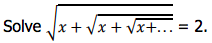
1.
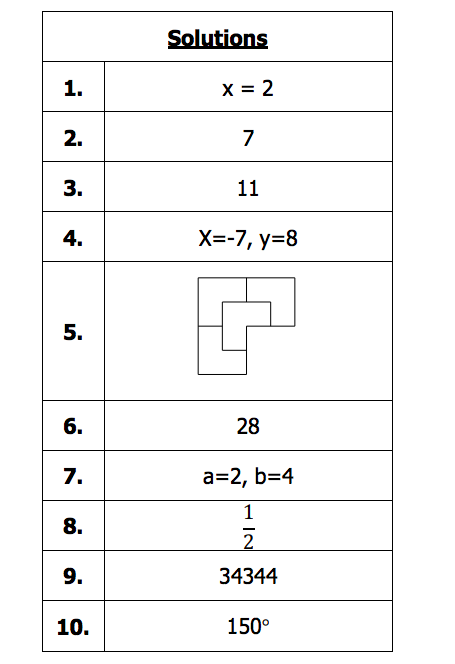
2. What is the maximum number of parts that can be obtained from cutting a circular disc using 3 straight cuts?
3. Find the next term of the following sequence: 2, 1, 3, 4, 7, …
4.
5. Divide the following shape into 4 identical parts.
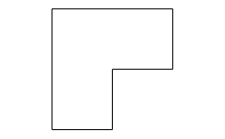
6. A perfect number is a positive integer that is equal to the sum of its proper positive factors. Proper positive factors of a number are positive factors that are less than the number. For example, 6 = 1 + 2 + 3 is a perfect number because 1, 2 and 3 are the only proper positive factors of 6. Find the next perfect number.
7. If and are positive whole numbers such that < and b = a? , find a possible value for and for .
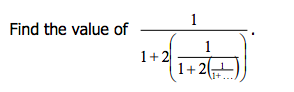
8.
9.
10. The diagram shows a triangle ABC where AB = AC, BC = AD and ∠BAC = 20°. Find ∠ADB.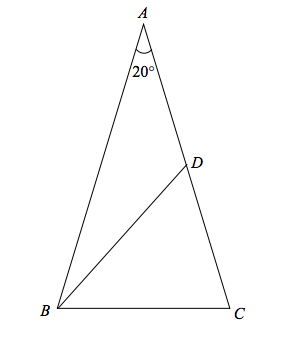
End of paper
以上就是關(guān)于【SASMO競賽七年級(初中一年級)樣題及答案】的解答,如需了解學(xué)校/賽事/課程動態(tài),可至翰林教育官網(wǎng)獲取更多信息。
往期文章閱讀推薦:
??2027年QS最佳留學(xué)城市排名發(fā)布!倫敦位列第三,北美竟無緣Top10 ?


翰林AMC8視頻課重磅上線!

國際競賽真題資源免費領(lǐng)取






