2000COMC加拿大數(shù)學公開賽真題答案免費下載

歷年 Canadian Open Mathematics Challenge加拿大數(shù)學公開賽
真題與答案下載

翰林國際教育全網(wǎng)首發(fā)
力爭超快速發(fā)布最全資料
助你在升學路上一帆風順
為你
千千萬萬遍
真題下載請前往【純真題】小程序
2000 COMC真題答案免費下載
共計2.5小時考試時間
此套試卷由兩部分題目組成
Part A共8題,每題5分
Part B共4題,每題10分
共計12題,滿分80分
不可使用任何計算器
完整版下載鏈接見文末
部分真題預(yù)覽:
Part A Solutions:
A2) The terms in the sequence are paired, by combining each odd-numbered term with the next term (that is, we combine terms 1 and 2, 3 and 4, 5 and 6, etc).
The sum of each of these pairs is 9.
So we need 20 of these pairs to reach a sum of 180.
Thus we need 2 × 20 or 40 terms.
ANSWER: 40
Part B Solutions:
B3)
- We first consider Alphonse’s possible moves to begin the game. We can assume, without loss of generality, that he cuts on the left side of the black triangle.
- Case 1:Alphonse removes two white triangles, leaving
 .
.
In this case, Beryl removes only one white triangle, and passes the shape back to Alphonse, forcing him to remove the last white triangle and lose.
 - Case 2:Alphonse removes one white triangle only, leaving
 .
.
Beryl removes both of the white triangles on the right, leaving Alphonse in the same position as in Case 1 for his second turn.
Therefore Beryl can always win, regardless of Alphonse’s strategy.
- Case 1:Alphonse removes two white triangles, leaving
- We show that, again, Beryl always has a winning strategy.
The strategy is to reduce the shape in Figure 2 to the shape in Figure 1, and to have Alphonse make the first cut at this stage. Beryl also knows that if she is forced into a position of being the first to cut when Figure 2 is reduced to Figure 1, then Alphonse can force her to lose.
We number the lines on the diagram for convenience.
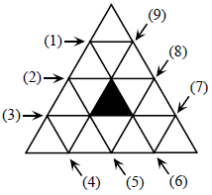
We can assume without loss of generality (because of symmetry) that Beryl cuts along (1), (2) or (3) to begin.
If she cuts (2) or (3), then Alphonse cuts the other of these two and leaves Beryl with Figure 1, where she will lose.
Therefore Beryl cuts (1) to begin.
If Alphonse now cuts (2) or (3), Beryl cuts the other of these two and passes the shape in Figure 1 back to Alphonse, and so he loses.
If Alphonse cuts (8) or (9), Beryl cuts the opposite and passes the shape in Figure 1 to Alphonse, and so he loses. (Similarly, if he cuts (5) or (6)).
So assume that Alphonse cuts (4) or (7), say (4) by symmetry.
If Beryl now cuts any of (2), (3), (5), (6), (8), or (9), then Alphonse can force Beryl to lose, in the same way as she could have forced him to lose, as above. So Beryl cuts (7).
Now Alphonse is forced to cut one of (2), (3), (5), (6), (8), or (9), and so Beryl makes the appropriate cut, passing the shape in Figure 1 back to Alphonse, and so he must lose.
Therefore Beryl always can have a winning strategy.
完整版真題資料可以底部二維碼免費領(lǐng)取↓↓↓
[vc_btn title="查看更多COMC加拿大數(shù)學奧賽相關(guān)詳情" color="primary" align="center" i_icon_fontawesome="fa fa-globe" css_animation="zoomIn" button_block="true" add_icon="true" link="url:http%3A%2F%2Fwww.linstitute.net%2Farchives%2F99767||target:%20_blank|"]
以上就是關(guān)于【2000COMC加拿大數(shù)學公開賽真題答案免費下載】的解答,如需了解學校/賽事/課程動態(tài),可至翰林教育官網(wǎng)獲取更多信息。
往期文章閱讀推薦:
【組隊招募】經(jīng)濟/數(shù)模競賽CNEC/IEO/SIC/HiMCM…組隊報名!


翰林AMC8視頻課重磅上線!

國際競賽真題資源免費領(lǐng)取






